

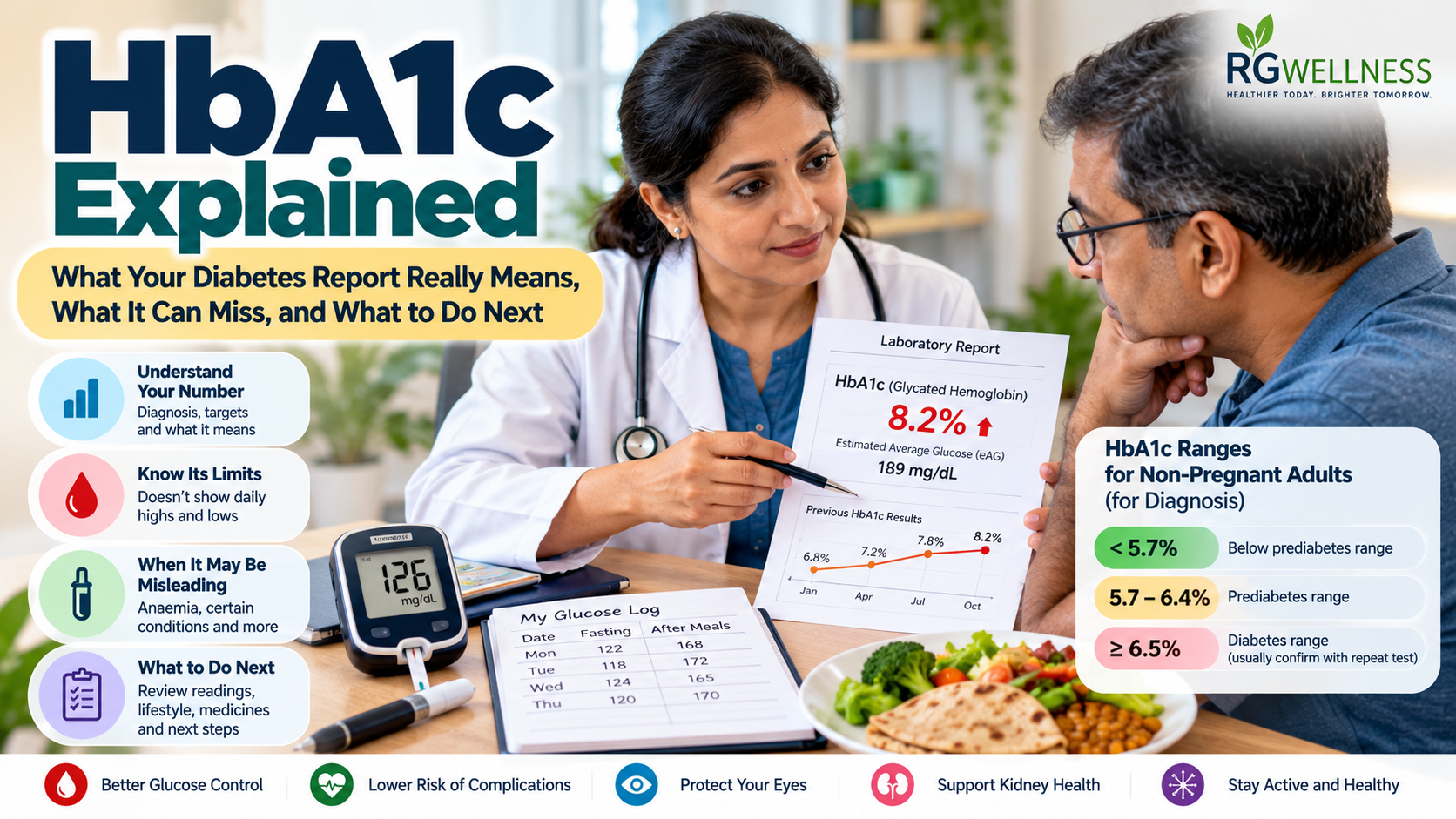

You have been taking your diabetes medicines, avoiding sweets, and trying to follow your diet. Then your laboratory report arrives: HbA1c 8.2%.
You feel confused. Your fasting blood sugar was only 125 mg/dL last week. You have also stopped adding sugar to your tea. So why is your HbA1c still high?
Another patient has an HbA1c of 6.8%, but occasionally experiences sweating, shakiness and weakness when glucose falls too low. Does that mean their diabetes is perfectly controlled?
These situations illustrate an important fact: HbA1c is one of the most useful tests in diabetes care, but it cannot tell the entire story of your blood sugar.
Understanding your result can help you discuss treatment more effectively, identify problems that a single number may hide, and make practical changes to your daily routine.
1. What Is HbA1c, and Why Does Your Doctor Order It?
HbA1c, also called glycated haemoglobin, measures the percentage of haemoglobin in red blood cells that has glucose attached to it.
Haemoglobin is the protein that carries oxygen throughout your body. When glucose circulates in your blood, some of it attaches to haemoglobin through a process called glycation.
The more glucose exposure your red blood cells experience, the higher your HbA1c generally becomes.
Because red blood cells circulate for a limited period, HbA1c reflects glucose exposure over approximately the previous two to three months. Recent glucose levels generally contribute more strongly than older levels.
Your doctor may order HbA1c to:
- Help diagnose diabetes or prediabetes.
- Assess longer-term glucose control.
- Evaluate whether a treatment plan is working.
- Decide whether additional glucose monitoring is needed.
- Discuss your risk of diabetes-related complications.
Unlike a fasting blood glucose test, HbA1c does not require fasting. However, it is not suitable for every diagnostic situation, particularly when certain medical conditions interfere with its accuracy.
2. What Do the HbA1c Numbers Mean?
For non-pregnant adults, the American Diabetes Association uses the following HbA1c categories for diagnosis.
| HbA1c result | General interpretation |
|---|---|
| Below 5.7% | Below the usual prediabetes threshold |
| 5.7–6.4% | Prediabetes range |
| 6.5% or higher | Diabetes range; confirmation is generally needed unless hyperglycaemia is unequivocal |
These thresholds help identify diabetes in people who have not already been diagnosed. They are not the same as treatment targets for people living with diabetes.
A diagnosis should be based on appropriate laboratory testing and clinical context. If a person has no unequivocal symptoms or hyperglycaemia, an abnormal diagnostic result generally needs confirmation with a repeat test or another accepted diagnostic test.
What if you already have diabetes?
For many non-pregnant adults with diabetes, an HbA1c target below 7% is commonly used. However, the right target depends on the individual.
Your doctor may consider a different target based on:
- Age and overall health.
- Duration of diabetes.
- Kidney disease, heart disease or other medical conditions.
- Risk of hypoglycaemia, or low blood glucose.
- Medicines being used.
- Frailty, daily functioning and treatment burden.
- Personal preferences and quality of life.
Remember: A result above 7% does not automatically mean that your treatment has failed, and a result below 7% does not guarantee that every aspect of glucose control is safe.
The goal is effective, sustainable control with the lowest reasonable risk of harm.
3. Why Can Your HbA1c Be High When Your Fasting Sugar Looks Normal?
This is one of the most common questions in diabetes consultations.
Imagine that your fasting glucose is 124 mg/dL, but your HbA1c is 8.1%.
These results may seem contradictory, but they measure different aspects of glucose control.
Fasting glucose is a measurement taken at a particular time. HbA1c reflects glucose exposure across many weeks.
Several explanations are possible.
Post-meal glucose rises: Your glucose may increase substantially after breakfast, lunch or dinner, even if your fasting value is acceptable.
High glucose at other times: Your glucose may be elevated during the afternoon, evening or overnight.
Recent improvement: You may have improved your glucose control during the last few weeks, while earlier high readings still contribute to HbA1c.
Differences in measurement: Your home glucose record may not capture all the times when glucose is elevated.
Biological interference: Anaemia, altered red blood cell turnover and some haemoglobin variants can affect the relationship between HbA1c and actual glucose.
The appropriate next step is to review the glucose pattern rather than assuming that one of the results must be wrong.
Your doctor may recommend structured home monitoring, post-meal measurements or continuous glucose monitoring, depending on your treatment and clinical circumstances.
4. The Same HbA1c Can Hide Very Different Glucose Patterns
Consider two hypothetical patients, both with an HbA1c of 7.5%.
| Feature | Patient A | Patient B |
|---|---|---|
| Overall HbA1c | 7.5% | 7.5% |
| Typical glucose pattern | Relatively stable | Large rises and occasional lows |
| Main concern | Whether overall control meets their target | Glucose variability and hypoglycaemia |
| Potential next step | Review the existing plan | Assess highs, lows and timing of medicines |
These examples are illustrative, not actual patient records.
Both patients have the same HbA1c, but their daily glucose experiences may be quite different.
One patient may have relatively steady readings. Another may experience high glucose after meals and low glucose at other times. HbA1c alone cannot distinguish these patterns.
This is particularly important for people taking insulin or certain medicines that can cause hypoglycaemia.
When appropriate, continuous glucose monitoring can provide additional information, including:
- Time in range: The percentage of time glucose remains within a defined target range.
- Time above range: How often glucose is higher than the selected range.
- Time below range: How often glucose falls below the selected range.
- Glucose variability: How much glucose fluctuates over time.
For many non-pregnant adults using continuous glucose monitoring, a commonly used target range is 70–180 mg/dL, with a general goal of spending more than 70% of the time within range. These targets must be individualised, particularly for people at higher risk of hypoglycaemia.
HbA1c and continuous glucose monitoring complement each other. Neither removes the need for clinical judgement.
5. What Does HbA1c 7%, 8% or 9% Mean in Everyday Life?
HbA1c can also be expressed as an estimated average glucose (eAG). This conversion gives patients another way to understand the result.
The following estimates use the commonly used equation relating HbA1c to average glucose.
| HbA1c | Estimated average glucose |
|---|---|
| 6.0% | 126 mg/dL |
| 6.5% | 140 mg/dL |
| 7.0% | 154 mg/dL |
| 7.5% | 169 mg/dL |
| 8.0% | 183 mg/dL |
| 8.5% | 197 mg/dL |
| 9.0% | 212 mg/dL |
| 10.0% | 240 mg/dL |
These values are approximate estimates, not predictions of your fasting glucose or the reading you will obtain after a meal.
For example, an HbA1c of 8% corresponds to an estimated average glucose of about 183 mg/dL. Your actual readings may be considerably lower or higher at different times.
A clinician should interpret the result alongside your glucose record, symptoms, medicines and medical history.
6. Can Anaemia Make Your HbA1c Wrong?
Yes. Certain blood conditions can make HbA1c less reliable.
This is important because a result that does not match the clinical picture should be investigated rather than accepted without question.
Iron-deficiency anaemia
Iron deficiency can raise HbA1c in some circumstances, even when glucose exposure has not increased proportionately. The size and direction of the effect vary, and iron deficiency does not affect every patient in the same way.
If your HbA1c seems unexpectedly high, your doctor may consider a complete blood count and iron studies when clinically indicated.
Haemolysis or recent blood loss
When red blood cells are destroyed more quickly or replaced following blood loss, they may have less time to accumulate glucose-related changes. HbA1c may therefore be lower than expected relative to actual glucose exposure.
Recent blood transfusion
A transfusion can alter the composition of circulating red blood cells and make HbA1c difficult to interpret for a period.
Kidney disease and dialysis
Advanced kidney disease may affect HbA1c interpretation through anaemia, changes in red blood cell survival and treatments such as erythropoietin. The relationship between HbA1c and glucose may be less predictable in some patients.
Haemoglobin variants
Certain haemoglobin variants interfere with specific HbA1c laboratory methods. Whether interference occurs depends on the variant and the assay used.
Practical advice: If your HbA1c seems inconsistent with your home readings, do not assume that the laboratory result is automatically wrong. Ask your clinician whether red blood cell conditions, the assay method or missing glucose measurements could explain the difference.
7. Can HbA1c Be Misleading During Pregnancy?
Pregnancy changes the clinical context and requires special consideration.
HbA1c alone is not the standard test for diagnosing gestational diabetes at the usual screening stage. Pregnancy-related changes in red blood cell turnover can also influence HbA1c interpretation.
People who are pregnant or planning pregnancy should follow a pregnancy-specific diabetes assessment and monitoring plan.
Glucose targets during pregnancy are different from those commonly used for non-pregnant adults, so do not apply a general adult HbA1c target without medical advice.
8. Why Did Your HbA1c Increase Even Though You Stopped Eating Sweets?
A common misconception is that avoiding sugar alone will bring HbA1c down.
Reducing added sugar can be helpful, but diabetes control depends on the overall dietary pattern, glucose regulation, physical activity, medication, sleep, illness and other factors.
For example, you may have stopped adding sugar to tea but still experience large glucose rises after meals. Or your fasting glucose may remain elevated because of the underlying progression of diabetes or another factor.
Other possible explanations include:
- Missed doses or difficulty following a medication schedule.
- A recent infection or other illness.
- Changes in physical activity or sleep.
- Medicines that raise glucose, such as corticosteroids.
- An inadequate treatment plan for your current needs.
- A change in the reliability of HbA1c because of a medical condition.
This does not mean that you should blame yourself or immediately increase medication.
Instead, review the result with your clinician and identify the most likely reason for the change.
9. Practical Indian Diet Changes That Can Support Better Glucose Control
You do not necessarily need to eliminate rice, roti, fruit or every carbohydrate-containing food.
What matters is the overall dietary pattern, appropriate portions, food quality and how your glucose responds.
Practical changes may include:
Breakfast: Consider options such as vegetable besan chilla, eggs with suitable whole-grain toast, or another balanced meal that provides protein and fibre.
Lunch: Combine suitable portions of roti or rice with dal or another protein source, vegetables and an appropriate amount of curd if tolerated.
Evening snacks: Consider unsweetened options such as nuts in appropriate portions, roasted chana or other foods that fit your individual nutrition plan.
Dinner: Choose a balanced meal and avoid routinely eating very large portions. If late meals aggravate your glucose pattern, discuss an appropriate meal schedule.
Beverages: Reduce sugar-sweetened tea, soft drinks and packaged sweetened beverages.
The right meal plan depends on your age, activity, medicines, glucose pattern and other conditions. People with kidney disease may require specific adjustments to protein, potassium, phosphorus or other dietary components.
Do not make extreme dietary changes to lower HbA1c quickly.
10. What Should You Do When Your HbA1c Is Higher Than Expected?
Use a structured approach rather than making decisions based on the number alone.
Step 1: Compare your previous results.
Look at the trend over time. A change from 6.9% to 7.2% may require a different response from a change from 7.0% to 9.2%.
Step 2: Review your glucose readings.
Include fasting and, when advised, post-meal readings. If you use continuous glucose monitoring, review time in range, time below range and variability.
Step 3: Review medication use.
Bring your complete medicine list and explain any missed doses, side effects, affordability concerns or difficulties following the schedule.
Step 4: Consider recent illness and other medical conditions.
Infections, corticosteroid treatment and other health changes may affect glucose. Anaemia and altered red blood cell turnover may affect HbA1c interpretation.
Step 5: Agree on a treatment plan.
Your clinician may recommend dietary changes, physical activity, medication adjustments or additional testing. Do not increase, reduce or stop diabetes medicines on your own.
If you experience symptoms of significant hyperglycaemia, repeated hypoglycaemia or acute illness, seek timely medical advice rather than waiting for the next HbA1c test.
11. How Often Should HbA1c Be Checked?
The frequency depends on whether glucose control is stable and whether treatment has changed.
- Approximately twice a year: Often appropriate for people whose treatment is stable and who are meeting their goals.
- Approximately every three months: Commonly considered when treatment has changed or glucose goals are not being met.
- More individualised monitoring: May be needed during pregnancy, significant illness or other circumstances requiring closer supervision.
Testing too soon after a treatment change may not fully reflect its longer-term effect. However, clinicians should respond to concerning glucose readings or symptoms without waiting for a new HbA1c.
12. Questions to Ask at Your Next Diabetes Appointment
Take your latest report, previous HbA1c values, glucose readings and medicine list to your appointment.
Ask your clinician:
- What is my individual HbA1c target?
- Does my result match my fasting and post-meal glucose readings?
- Could anaemia, kidney disease or another condition affect this result?
- Would structured home monitoring or continuous glucose monitoring help?
- Is my treatment plan appropriate for my current glucose pattern?
- When should my next HbA1c test be performed?
These questions help turn a laboratory result into a practical diabetes management plan.
Frequently Asked Questions
Does HbA1c show my blood sugar on the day of the test?
No. HbA1c reflects glucose exposure over recent weeks and months. A fasting glucose test measures blood glucose at a particular time.
Can HbA1c improve in less than three months?
Yes. Recent glucose changes can influence HbA1c before a full three months have passed, although earlier glucose exposure continues to contribute.
Can someone have a reasonable HbA1c and still experience low blood sugar?
Yes. HbA1c does not show individual high and low episodes. People at risk of hypoglycaemia may need additional glucose monitoring.
Does HbA1c above 7% always mean that medication needs to be increased?
No. Your clinician should assess your individual target, glucose pattern, medication use, health conditions and the reliability of the result before changing treatment.
Should every person with diabetes aim for HbA1c below 7%?
No. This is a common goal for many non-pregnant adults, but targets should be individualised according to expected benefit, hypoglycaemia risk, other conditions and treatment burden.
Can iron deficiency affect HbA1c?
Yes. Iron-deficiency anaemia can affect HbA1c in some circumstances. The result should be interpreted alongside glucose measurements and relevant blood tests.
Final Takeaway: Treat the Patient, Not Just the HbA1c Number
HbA1c is an essential tool in diabetes care, but it is not a complete record of daily glucose.
A result of 8% may reflect persistent high glucose, post-meal rises, recent changes in control or a combination of factors. In some circumstances, a blood condition can also make the result less reliable.
The best approach is to interpret HbA1c alongside glucose patterns, medical history, treatment and personal goals.
Your HbA1c is not a judgement of your effort. It is information that helps you and your clinician decide what to do next.
At RGWELLNESS, the goal is to make diabetes reports easier to understand and help patients take practical, evidence-based steps towards better health.
Medical Disclaimer
This article is for educational purposes and does not replace personalised medical advice. Diagnosis, treatment targets and medication changes should be decided with a qualified healthcare professional.
References
- American Diabetes Association Professional Practice Committee. Diagnosis and Classification of Diabetes: Standards of Care in Diabetes—2026. Diabetes Care, 2026.
- National Institute of Diabetes and Digestive and Kidney Diseases. The A1C Test & Diabetes.
- American Diabetes Association Professional Practice Committee. Glycemic Goals, Hypoglycemia, and Hyperglycemic Crises: Standards of Care in Diabetes—2026. Diabetes Care, 2026.
