How to Choose the Right BP Monitor for Home Use
A practical guide to choosing an upper-arm BP monitor, checking cuff size, understanding useful features and measuring blood pressure correctly at home.

Why Does the Choice of BP Monitor Matter?
Home blood-pressure monitoring can be useful for people who need regular measurements. However, the quality of the device, cuff size and measurement technique can all influence the result.
For most adults, an automatic upper-arm cuff monitor is the preferred type for routine home blood-pressure monitoring.
Before You Buy: Quick Checklist
Tap each item after checking it on the BP monitor you are considering.
Upper-Arm vs Wrist BP Monitor
One of the first decisions is choosing between an upper-arm and wrist monitor.
Upper-Arm
Preferred choice for routine home monitoring
- Automatic models widely available
- Generally easier to standardize
- Suitable for most adults
- Important to use the correct cuff size
Wrist
More sensitive to positioning
- Small and portable
- Can be convenient in some situations
- Requires careful positioning
- Not generally the first choice for routine monitoring
📏 Don’t Ignore Cuff Size
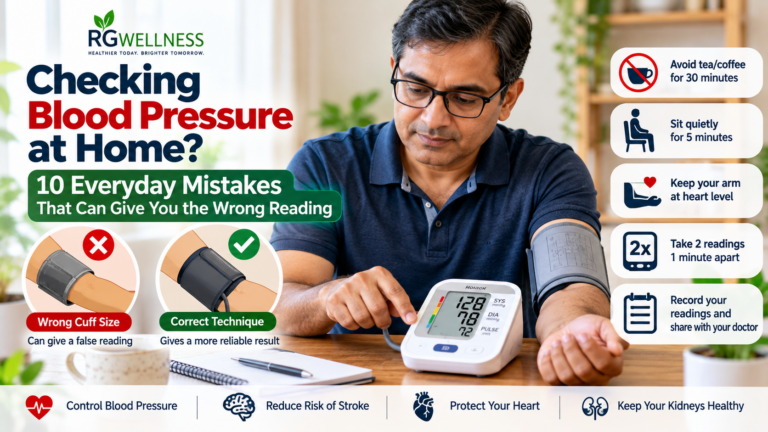
A BP monitor can be technically good, but the measurement may be affected if the cuff does not fit the person’s arm correctly.

✅ Look for a Validated Monitor
Don’t choose a BP monitor only because its packaging says “high accuracy” or “smart.”
Where possible, look for devices that have undergone an appropriate clinical validation process.
Which Features Are Actually Useful?
🪑 How to Measure BP Correctly
Choosing the right monitor is only half the job. Correct measurement technique is equally important.
Sit quietly for about 5 minutes.
Back supported and feet flat.
Place correctly on the bare upper arm.
Keep the arm supported and don’t talk.
Take repeated readings and record them.

Things to Avoid Before Measuring
Which Type Should You Consider?
Select the situation that best matches your needs.
RG Wellness BP Monitor Buying Checklist
| Feature | Priority | Why It Matters |
|---|---|---|
| Automatic upper-arm cuff | Essential | Preferred format for routine home monitoring. |
| Correct cuff size | Essential | Improves the chance of obtaining a useful measurement. |
| Validated accuracy | Essential | Provides evidence supporting measurement accuracy. |
| Memory | Useful | Helps track previous readings. |
| Large display | Useful | Improves readability. |
| Bluetooth/app | Optional | Useful if you want digital record keeping. |
📝 Keep a Simple BP Record
| Date | Time | Reading 1 | Reading 2 | Pulse |
|---|---|---|---|---|
| ________ | Morning | ___ / ___ | ___ / ___ | ___ |
| ________ | Evening | ___ / ___ | ___ / ___ | ___ |
| ________ | Morning | ___ / ___ | ___ / ___ | ___ |
RG Wellness Quick Summary
- Measure your upper-arm circumference.
- Choose an automatic upper-arm monitor.
- Check that the cuff fits.
- Look for appropriate validation of the device.
- Choose features you will actually use.
- Learn the correct measurement technique.
- Keep a record of your readings.
🛒 Explore BP Monitors
Compare available blood-pressure monitors through the RG Wellness Store on Amazon.
View BP Monitors on Amazon →⚠️ Important Health Information
A home BP monitor is a monitoring tool and does not replace medical evaluation.
If a reading is very high, repeat the measurement correctly. Persistent readings above 180/120 mmHg require prompt medical attention, particularly when accompanied by concerning symptoms.
Frequently Asked Questions
Which type of BP monitor is generally preferred?
An automatic upper-arm cuff monitor is generally preferred for routine home blood-pressure monitoring.
Is cuff size important?
Yes. The cuff should correspond to the circumference of the upper arm. An inappropriate cuff can affect measurement accuracy.
Are wrist BP monitors accurate?
Wrist monitors can be more sensitive to positioning and are generally not the first choice for routine home monitoring.
Should I take more than one reading?
Taking repeated readings can provide a more useful picture than relying on a single isolated measurement. Follow your clinician’s instructions for your specific monitoring schedule.
Can I use my BP monitor during a doctor’s visit?
Yes. Bringing your home monitor to a healthcare appointment can allow the clinician to compare it with the equipment used in the clinical setting and review your measurement technique.
Medical Disclaimer:This article is for general educational purposes and should not replace individualized medical advice, diagnosis or treatment.