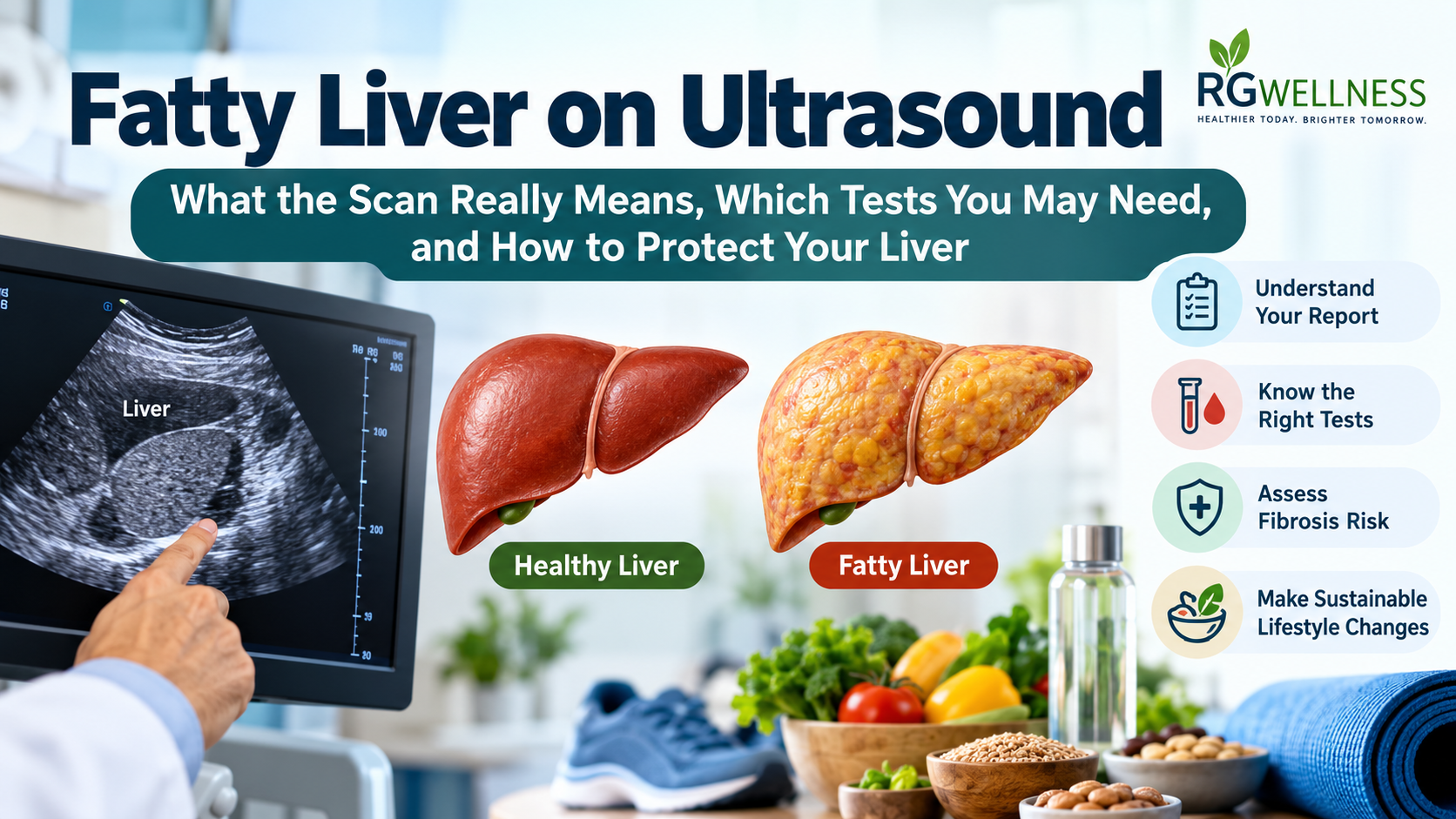

If your ultrasound report says “fatty liver,” “hepatic steatosis,” or “increased liver echogenicity,” it usually means that fat has accumulated in your liver. This finding does not automatically mean that you have liver damage, cirrhosis, or liver failure.
However, an ultrasound cannot reliably determine whether significant liver scarring (fibrosis) is present. The next step is to review your metabolic health, relevant blood tests, alcohol intake, medicines, and individual risk factors. Your doctor may recommend a fibrosis-risk score or liver elastography, commonly known as FibroScan, depending on your clinical assessment.
The reassuring message is that many people with early fatty liver can improve their liver health through sustainable lifestyle changes and appropriate management of associated medical conditions.
1. What Does Fatty Liver Mean on an Ultrasound Report?
Your liver performs several important functions, including processing nutrients, producing bile, storing energy, and helping the body metabolise medicines.
When excess fat accumulates in liver cells, the condition is called hepatic steatosis, commonly known as fatty liver.
Ultrasound reports may use terms such as:
- Mild fatty liver: The scan suggests a relatively subtle increase in liver brightness.
- Moderate fatty liver: The appearance of fat accumulation is more pronounced.
- Severe fatty liver: The ultrasound appearance suggests more marked steatosis.
- Increased hepatic echogenicity: The liver appears brighter than expected on ultrasound.
These descriptions refer primarily to the appearance of the liver on imaging. They do not directly measure inflammation or the degree of fibrosis.
A report describing severe fatty liver does not necessarily mean severe scarring, and a report describing mild fatty liver does not guarantee that fibrosis is absent.
What this means for you: Do not judge the seriousness of your liver condition by the ultrasound grade alone. Your medical history, examination, laboratory findings, and fibrosis-risk assessment provide additional information.
2. What Is MASLD? Understanding the New Name for Fatty Liver Disease
You may see different names for fatty liver disease in older and newer medical publications.
MASLD stands for metabolic dysfunction-associated steatotic liver disease. It is the current terminology for a form of steatotic liver disease associated with at least one cardiometabolic risk factor.
Older medical literature commonly uses the term NAFLD, meaning non-alcoholic fatty liver disease. Another older term, NASH, describes fatty liver disease associated with inflammation and liver-cell injury. The newer corresponding term is MASH, or metabolic dysfunction-associated steatohepatitis.
MASLD may occur alongside:
- Type 2 diabetes or prediabetes
- High triglycerides or abnormal cholesterol
- High blood pressure
- Excess abdominal fat or overweight
- Other features of metabolic dysfunction
Fat can also accumulate in the liver for other reasons, including alcohol exposure, certain medicines, and specific medical conditions. Therefore, an appropriate assessment should consider the possible cause rather than assume that every case is MASLD.
3. Can an Ultrasound Tell You Whether Your Liver Is Damaged?
This is one of the most important questions patients should ask.
A conventional ultrasound can identify moderate or more obvious fat accumulation and may reveal structural abnormalities. However, it cannot reliably distinguish simple steatosis from all forms of inflammatory liver disease or accurately stage fibrosis.
| Investigation | What it can help assess | Important limitation |
|---|---|---|
| Abdominal ultrasound | Fatty appearance and liver structure | Cannot reliably stage fibrosis |
| ALT and AST | Liver-cell injury or inflammation may be suspected | Normal values do not exclude advanced fibrosis |
| Platelet count | Helps assess certain patterns associated with advanced liver disease | Cannot diagnose fibrosis by itself |
| FIB-4 score | Estimates the risk of advanced fibrosis using age, AST, ALT and platelets | A risk-assessment tool, not a definitive diagnosis |
| FibroScan or other elastography | Estimates liver stiffness and, with appropriate methods, may assess steatosis | Results require clinical interpretation |
| Liver biopsy | Can assess microscopic inflammation and fibrosis when indicated | Invasive; not routinely required for every patient |
These distinctions are consistent with guidance from the American Association for the Study of Liver Diseases (AASLD), the European liver societies (EASL–EASD–EASO), and the US National Institute of Diabetes and Digestive and Kidney Diseases (NIDDK).
4. Why Is Liver Fibrosis More Important Than the Ultrasound Grade?
Fat accumulation and fibrosis are different aspects of liver disease.
Fibrosis develops when ongoing liver injury leads to scar tissue formation. Advanced fibrosis can increase the risk of cirrhosis and liver-related complications.
Clinicians therefore try to identify people who may have significant fibrosis, particularly those with type 2 diabetes, multiple metabolic risk factors, persistently abnormal liver tests, or other concerning clinical findings.
The following simplified pathway explains the difference.
Step 1: Identify the possible cause. Review metabolic conditions, alcohol intake, medicines, medical history and other potential liver diseases.
Step 2: Review relevant investigations. Depending on the patient, these may include liver enzymes, a complete blood count with platelets, glucose or HbA1c, lipids, and other targeted tests.
Step 3: Estimate fibrosis risk. A clinician may calculate FIB-4 using age, AST, ALT and platelet count.
Step 4: Consider further assessment when indicated. If the initial score suggests increased or indeterminate risk, liver elastography or specialist review may be appropriate.
Step 5: Plan follow-up. The timing and type of repeat assessment depend on the initial findings, metabolic risk and clinical course.
This stepwise approach helps avoid two common mistakes: ordering advanced investigations for everyone without considering risk, and overlooking fibrosis in someone whose ultrasound or liver enzymes appear reassuring.
What Does a FIB-4 Score Mean?
In many adults, a FIB-4 score below 1.3 is used as a first-line indicator of a lower probability of advanced fibrosis. A score of 1.3 or above commonly prompts consideration of a second-line assessment, such as elastography, depending on the clinical setting.
These thresholds are not universal diagnostic boundaries. Interpretation differs in older adults and younger people, and FIB-4 is less accurate in people under 35 years of age. It should not be relied on during an acute illness that may distort laboratory results.
Important: A low score reduces concern but does not eliminate every possibility of advanced fibrosis. A clinician should interpret the score alongside the patient’s history and other findings.
5. Which Blood Tests May Be Needed After a Fatty Liver Ultrasound?
There is no single mandatory test panel for every patient. Your clinician will select investigations according to your history and risk profile.
Commonly considered tests include:
- Liver profile: ALT, AST, bilirubin, alkaline phosphatase and other components when indicated.
- Complete blood count: Including platelet count, which contributes to FIB-4 assessment.
- Blood glucose or HbA1c: To assess diabetes or prediabetes.
- Lipid profile: To assess cholesterol and triglyceride levels.
- Additional tests when indicated: For example, hepatitis testing or investigations for other liver conditions if the history, examination or laboratory results suggest them.
Normal liver enzymes should not be taken as proof that the liver has no significant fibrosis. Likewise, elevated liver enzymes do not establish that fatty liver is the only cause.
Bring your previous reports and current medicine list to your appointment. Comparing results over time can be more informative than interpreting a single result in isolation.
6. Can Fatty Liver Be Reversed Naturally?
In many people, liver fat can decrease when the underlying metabolic factors improve. The degree of improvement depends on the cause, the presence of fibrosis, associated illnesses and the sustainability of treatment.
The best-supported starting point is not a detox product or a special drink. It is a structured approach to food, physical activity and management of associated medical conditions.
Follow a Sustainable, Balanced Diet
For Indian patients, practical dietary changes may include:
- Make vegetables, pulses, beans and other fibre-rich foods regular parts of meals.
- Choose suitable portions of whole grains, such as whole-wheat roti, oats or other minimally processed grains.
- Include appropriate protein sources, such as dal, beans, curd, eggs, fish or other foods consistent with your dietary preferences and medical needs.
- Reduce frequent sugary drinks, packaged sweetened beverages and excess added sugar.
- Limit frequent consumption of deep-fried foods, refined snacks and foods high in saturated fat.
- Pay attention to portion sizes and overall dietary quality rather than eliminating all carbohydrates.
You do not need to stop eating rice or roti automatically. The appropriate amount depends on your total dietary pattern, activity, glucose control and individual energy needs.
People with kidney disease or other conditions requiring dietary restrictions may need a specifically tailored plan.
Be Physically Active
Regular physical activity can improve metabolic health and reduce liver fat, including in some people who do not experience substantial weight change.
Choose activities appropriate to your health and fitness, such as brisk walking, cycling or other aerobic exercise. Build up gradually and incorporate muscle-strengthening activity when medically suitable.
If you have significant heart disease, mobility problems or another condition affecting exercise safety, discuss an appropriate activity plan with your clinician.
If Weight Reduction Is Appropriate, Aim for Gradual Progress
For adults with overweight or obesity, gradual, sustainable weight reduction can improve liver fat and other metabolic risk factors. Larger reductions may provide additional benefits in some patients, but the appropriate goal depends on the individual.
Avoid crash diets, prolonged fasting without appropriate supervision, and extreme dietary restrictions. A nutrition plan should preserve adequate nutrition and be realistic enough to maintain.
Address Diabetes, Blood Pressure and Cholesterol
Fatty liver is not solely a liver problem. It is often linked with broader metabolic health.
Work with your clinician to manage blood glucose, blood pressure and lipid levels. Take prescribed medicines as directed, and do not discontinue them because an ultrasound shows fatty liver.
Avoid unverified liver supplements and detox products. Some herbal and dietary preparations can cause liver injury or interact with medicines.
What About Alcohol?
Discuss alcohol intake honestly with your clinician. Advice should reflect the underlying cause of liver disease, the degree of liver damage and other health factors. Avoiding alcohol is particularly important when alcohol contributes to liver injury or advanced liver disease is suspected.
7. Do You Need FibroScan?
Not everyone with fatty liver needs FibroScan immediately.
FibroScan is a form of vibration-controlled transient elastography. It estimates liver stiffness, which can help assess fibrosis risk. Some versions also estimate liver fat using a controlled attenuation parameter.
Your clinician may consider it when:
- FIB-4 suggests increased or indeterminate fibrosis risk.
- You have type 2 diabetes or several metabolic risk factors.
- Liver tests remain abnormal without a clear explanation.
- Other findings raise concern about chronic liver disease.
- A specialist needs further information to guide management.
Liver stiffness can be influenced by factors other than fibrosis, including active inflammation and other clinical circumstances. FibroScan results should therefore be interpreted in context.
A routine liver ultrasound and FibroScan are not interchangeable tests: they answer different clinical questions.
8. Does Everyone With Fatty Liver Need a Liver Specialist?
No. Many patients can begin assessment and management with a primary-care clinician or physician.
Referral to a gastroenterologist or hepatologist may be appropriate if non-invasive tests suggest advanced fibrosis, other investigations are concerning, liver abnormalities remain unexplained, another liver disease is suspected, or clinical signs suggest advanced disease.
A specialist may recommend additional testing based on the overall clinical picture. Liver biopsy is reserved for selected situations in which the result is expected to affect diagnosis or management.
The aim is to identify higher-risk patients without subjecting everyone to unnecessary investigations.
9. Warning Signs You Should Not Ignore
Fatty liver is often discovered incidentally, and many people have no symptoms. However, certain symptoms require prompt medical attention.
Seek urgent assessment for:
- New jaundice (yellowing of the eyes or skin)
- New or rapidly increasing abdominal swelling
- Vomiting blood or passing black, tarry stools
- New confusion or marked drowsiness
- Severe deterioration in general health
These symptoms are not typical consequences of an uncomplicated ultrasound finding and may indicate serious liver disease or another urgent condition.
Do not wait for a routine follow-up appointment if these symptoms occur.
10. A Practical Checklist for Your Doctor’s Appointment
If your ultrasound report mentions fatty liver, take the following steps:
Bring the complete ultrasound report, including any other findings.
Review your medicines, supplements and alcohol history with your clinician.
Check whether glucose or HbA1c and lipid testing are appropriate.
Review liver enzymes and platelet count.
Ask whether a FIB-4 assessment is suitable for your age and clinical situation.
Discuss whether elastography or specialist referral is indicated.
Agree on realistic dietary, activity and metabolic-health goals.
Establish an appropriate follow-up plan.
You do not necessarily need every investigation on this list. Your clinician can prioritise the tests that are most likely to change your care.
Frequently Asked Questions About Fatty Liver on Ultrasound
Does fatty liver on ultrasound mean I have cirrhosis?
No. Fatty liver on ultrasound does not establish cirrhosis. Fibrosis risk must be assessed separately using clinical evaluation and appropriate non-invasive tests.
Can liver enzymes be normal even if I have fibrosis?
Yes. Normal ALT and AST levels do not reliably exclude advanced fibrosis. Risk assessment should consider the broader clinical picture.
Is mild fatty liver harmless?
Not necessarily. Many people with mild steatosis have a low risk of advanced liver disease, but the ultrasound grade alone cannot establish that risk. Diabetes, metabolic factors and fibrosis assessment may influence management.
Can I cure fatty liver by drinking lemon water or another detox drink?
There is no reliable evidence that a particular detox drink removes fatty liver or reverses fibrosis. Sustainable dietary changes, regular activity and appropriate management of metabolic conditions are more useful approaches.
Should I stop rice and roti if I have fatty liver?
Not automatically. Appropriate portions and the overall quality of your diet matter more than eliminating one staple food. Individual advice is particularly important if you also have diabetes or kidney disease.
Does everyone with fatty liver need FibroScan?
No. FibroScan is considered according to the patient’s risk factors, first-line assessment and clinical findings. Some patients can be managed initially without it.
Can fatty liver occur in people who are not overweight?
Yes. Fatty liver can occur in people without obesity. Metabolic risk factors, body-fat distribution, medicines and other causes may contribute.
How often should fatty liver be monitored?
There is no single interval suitable for everyone. Follow-up depends on fibrosis risk, diabetes and other metabolic conditions, laboratory findings and the treatment plan.
Is there a medicine that treats fatty liver?
Treatment depends on the cause, the degree of liver disease and associated conditions. Some patients may benefit from medicines prescribed for diabetes, obesity or specific forms of liver disease. These treatments are not appropriate for everyone, and medication decisions should be made by a qualified clinician.
Expert Perspective: What Do Current Liver Guidelines Emphasise?
Three important sources support the central message of this article:
1. American Association for the Study of Liver Diseases (AASLD)
The AASLD practice guidance recommends fibrosis-risk assessment for patients with suspected or confirmed fatty liver in appropriate clinical settings. It supports using FIB-4 as an initial assessment in many adults, followed by a second-line test or referral when indicated. It also cautions against using normal aminotransferase levels alone to exclude advanced disease.
Read the AASLD practice guidance on fatty liver disease.
2. EASL–EASD–EASO clinical practice guidelines
The 2024 European guidelines recommend a stepwise approach to identifying advanced fibrosis in people with relevant metabolic risks or other clinical indications. This commonly begins with a blood-based score such as FIB-4, followed when appropriate by liver elastography or another validated assessment.
Read the 2024 European MASLD clinical practice guidelines.
3. National Institute of Diabetes and Digestive and Kidney Diseases (NIDDK)
NIDDK explains that clinicians use medical history, examination, blood tests and imaging to evaluate fatty liver. Routine imaging cannot reliably establish microscopic inflammation or fibrosis, and additional assessment may be needed.
Read the NIDDK guide to fatty liver diagnosis.
Practical clinical interpretation: The important question is not simply whether fat is visible on a scan. It is whether the patient has an underlying condition that needs treatment and whether the available findings suggest a risk of significant fibrosis.
Related Articles for Patients
Explore these related topics to understand fatty liver and its management in more detail:
- [Fatty Liver Diet Plan: Indian Foods, Portions and Practical Changes] — How to plan balanced meals, manage portions and reduce excess added sugar.
- [FibroScan Explained: What Liver Stiffness Results Mean] — Understand why elastography may be recommended and what it can and cannot tell you.
- [FIB-4 Score Explained: A Blood-Test-Based Assessment of Liver Fibrosis Risk] — Learn how age, AST, ALT and platelet count contribute to a fibrosis-risk estimate.
- [Fatty Liver and Diabetes: Understanding the Metabolic Connection] — Why glucose control and liver health are often closely linked.
- [High Triglycerides and Fatty Liver: What Patients Should Know] — How lipid abnormalities fit into a broader metabolic assessment.
- [Normal Liver Function Tests: Can Liver Disease Still Be Present?] — Understand the limitations of normal laboratory results.
- [Fatty Liver Myths: Detox Drinks, Supplements and Common Misconceptions] — Separate evidence-based care from unsupported claims.
Editorial note: These are suggested related-article titles. Add links only after the corresponding articles are published and their final URLs are verified.
Final Takeaway
A fatty liver ultrasound report is a reason to assess your liver health, not a reason to assume the worst.
Ultrasound can suggest fat accumulation, but it cannot reliably determine the degree of liver scarring. A structured clinical review, appropriate blood tests, risk-based fibrosis assessment and sustainable lifestyle changes help patients and clinicians decide what needs attention.
The goal is simple: understand the cause, assess the risk, and take the right next step—without unnecessary alarm or false reassurance.
Medical Disclaimer
This article is for general educational purposes and does not replace a personalised medical consultation. Investigation and treatment decisions should be based on an individual’s age, medical history, examination and test results.