
Keto, low-carb diets, intermittent fasting, high-protein diets and meal-replacement plans are everywhere. But when someone asks, “What is the best diet for weight loss?”, the answer should not be another restrictive food list.
The best diet for weight loss is an eating pattern that helps manage energy intake, provides adequate nutrition and fits your health needs, food preferences and daily routine.
A sustainable weight-management plan does not necessarily require eliminating rice, roti or other traditional Indian foods. Instead, it focuses on portion control, balanced meals, adequate protein, vegetables, fibre-rich foods and consistent lifestyle habits.
The National Institute of Diabetes and Digestive and Kidney Diseases (NIDDK) similarly emphasizes that a healthy eating plan should be sustainable over time and combined with appropriate physical activity.
What Is the Best Diet for Weight Loss?
There is no single diet that is ideal for every person.
A suitable weight-loss diet should consider:
- Current weight and nutritional status
- Height and body composition
- Age
- Physical activity
- Food preferences
- Vegetarian or non-vegetarian eating pattern
- Meal timing
- Medical conditions
- Medications
- Lifestyle and work schedule
- Individual weight-management goals
Different dietary patterns can help people lose weight. The most useful approach is usually the one that is nutritionally adequate, realistic and sustainable.
The CDC also emphasizes that healthy weight management involves nutrition, physical activity, adequate sleep and stress management rather than relying on a single diet rule.
1. The Foundation of a Weight-Loss Diet: Appropriate Portions
Weight loss generally requires reducing the amount of energy consumed relative to energy used over time.
This does not mean that you need to count every calorie forever.
Portion awareness can be a practical alternative.
For example, instead of completely eliminating rice:
Choose an appropriate portion of rice + dal + vegetables + salad + curd.
Instead of removing roti:
Choose an appropriate number of rotis + protein-rich food + vegetables.
The overall meal matters more than declaring one food “good” or “bad.”
NIDDK recommends healthy eating patterns that include vegetables, fruits, whole grains and appropriate protein sources while reducing calorie intake when weight loss is required.
2. Include Protein in Your Weight-Loss Diet
Protein is an important part of a balanced weight-management diet.
Useful Indian protein sources include:
Vegetarian
- Dal
- Chana
- Rajma
- Soy
- Tofu
- Paneer
- Curd
- Milk
- Sprouts
- Peas
- Nuts and seeds
Non-vegetarian
- Eggs
- Fish
- Chicken
- Other suitable lean protein sources
Including an appropriate protein source with meals can make the diet more satisfying and can help support nutritional adequacy during weight management.
However, more protein is not automatically better. People with kidney disease or other medical conditions may require individualized protein recommendations.
3. Do You Need to Stop Eating Rice or Roti?
No.
This is one of the most common misconceptions about Indian weight loss.
Rice and roti can both be included in a healthy diet.
The important factors include:
- Portion size
- Preparation method
- Overall meal composition
- Physical activity
- Total dietary intake
For example:
Less balanced meal
Large portion of rice + fried food + sugary drink
More balanced meal
Appropriate rice portion + dal + vegetables + salad + curd
The second meal provides a more balanced nutritional pattern without requiring rice to be eliminated.
The CDC advises that healthy eating is generally better approached through a variety of nutritious foods rather than eliminating an entire food category such as carbohydrates.
4. Choose More Vegetables and Fibre-Rich Foods
Vegetables can make meals more nutritious while adding volume and variety.
Try including:
- Green leafy vegetables
- Gourds
- Beans
- Cabbage
- Cauliflower
- Carrot
- Tomato
- Capsicum
- Seasonal vegetables
- Salads where appropriate
Fibre-rich foods can also include:
- Pulses
- Beans
- Whole grains
- Vegetables
- Whole fruits
- Seeds
- Appropriate nuts
Whole fruit is generally preferable to relying heavily on fruit juice because it provides fibre and requires chewing.
5. Limit Foods That Make Calorie Control Difficult
Weight management does not require a permanent list of forbidden foods.
However, frequent intake of energy-dense foods can make an appropriate calorie intake more difficult.
Consider reducing:
- Sugar-sweetened beverages
- Frequent sweets
- Deep-fried snacks
- Highly processed foods
- Large portions of bakery products
- Fast food
- Sugary desserts
- Frequent packaged snacks
The objective is not perfection.
It is to make nutritious foods the foundation of your normal eating pattern.
6. Is a Low-Carbohydrate Diet the Best Diet for Weight Loss?
Low-carbohydrate diets can work for some people, but they are not automatically the best option for everyone.
A lower-carbohydrate eating pattern may reduce foods such as:
- Sugary drinks
- Sweets
- Refined snacks
- Large portions of refined grains
However, eliminating all carbohydrates is unnecessary for most people.
Vegetables, fruits, pulses and whole grains can provide important nutrients and fibre.
If someone has diabetes, kidney disease, liver disease, is pregnant or breastfeeding, or takes medications affected by dietary intake, a restrictive low-carbohydrate approach may require professional assessment.
7. What About Intermittent Fasting?
Intermittent fasting is another popular weight-management strategy.
Some people use time-restricted eating because it helps them reduce late-night eating or unnecessary snacking.
However, intermittent fasting is not essential for weight loss.
The most useful eating schedule is one that:
- Fits your daily routine
- Supports adequate nutrition
- Does not cause excessive hunger
- Is sustainable
- Is appropriate for your medical situation
People using glucose-lowering medicines should obtain appropriate professional advice before substantially changing meal timing.
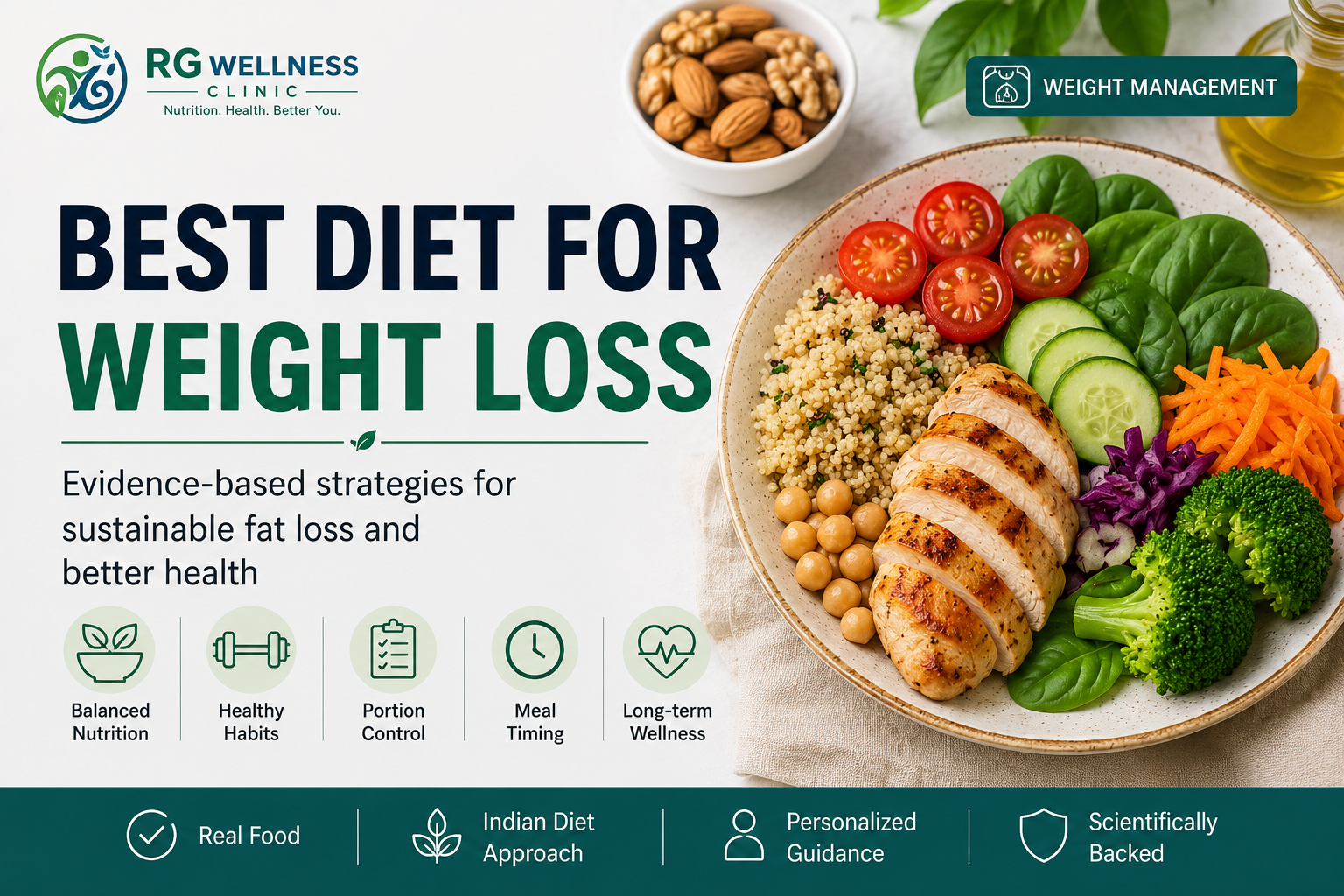
A Practical Indian Weight-Loss Plate
Instead of following complicated diet rules, use a simple meal structure.
Vegetables
Make vegetables a substantial part of lunch and dinner.
Protein
Include dal, beans, curd, paneer, tofu, eggs, fish or another suitable protein source.
Carbohydrate
Use an appropriate portion of:
- Roti
- Rice
- Dalia
- Oats
- Millets
- Other suitable whole or minimally processed grains
Healthy fats
Use appropriate amounts of nuts, seeds and cooking oils.
The correct quantity depends on the individual’s nutritional requirements.
Sample Indian Weight-Loss Meal Plan
This is an illustrative example, not an individualized prescription.
Breakfast
Choose one:
- Vegetable poha + curd
- Moong-dal chilla + curd
- Vegetable oats
- Idli + sambar
- Eggs + vegetables
Mid-Morning
- One whole fruit, if appropriate
Lunch
- Roti or rice
- Dal/beans or another protein source
- Seasonal vegetables
- Salad
- Curd where appropriate
Evening
- Roasted chana
- Fruit
- Makhana
- Appropriate portion of nuts
- Unsweetened beverage
Dinner
- Vegetables
- Protein-rich food
- Appropriate portion of roti/rice
The quantities should be individualized rather than copied from a generic online chart.
Weight Loss Is Not Only About Food
A professional weight-management strategy should also consider:
Physical activity
Regular physical activity supports overall health and can contribute to weight management. Current CDC guidance recommends at least 150 minutes of moderate-intensity aerobic activity per week for most healthy adults, along with muscle-strengthening activity on at least two days per week, while individual needs vary.
Sleep
Adequate sleep is an important part of healthy lifestyle management.
Stress
Stress can influence eating patterns and daily lifestyle behaviours.
Daily movement
Walking, taking stairs and reducing prolonged sitting can complement structured exercise.
How Fast Should You Lose Weight?
Avoid unrealistic promises of losing a large amount of weight in a very short time.
The appropriate rate varies between individuals.
The CDC notes that people who lose weight gradually and steadily are generally more likely to maintain weight loss than those who lose weight very rapidly.
The objective should therefore be:
Healthy progress + nutritional adequacy + long-term maintenance.
Not:
Maximum weight loss in the shortest possible time.
Who Needs a Personalized Weight-Loss Diet?
A generic diet chart may not be appropriate for everyone.
Individualized nutrition planning can be particularly important for people with:
- Diabetes
- Prediabetes
- Hypertension
- Kidney disease
- Fatty liver disease
- Cardiovascular disease
- Thyroid-related nutritional concerns
- PCOS
- Pregnancy
- Lactation
- Multiple medications
- Significant nutritional deficiencies
A personalized plan can consider health history, medications, laboratory information, food preferences, meal timing and lifestyle.
RG Wellness Clinic’s Personalized Diet Plans service describes this individualized approach.
Common Weight-Loss Mistakes
Eliminating All Carbohydrates
Rice and roti do not automatically prevent weight loss.
Better approach: manage portions and improve the overall meal.
Skipping Meals Without a Plan
Skipping meals is not automatically necessary for weight loss.
Better approach: develop a meal pattern that suits your routine.
Depending on “Fat-Burning” Foods
No single food can selectively remove body fat.
Better approach: focus on the complete eating pattern.
Following Someone Else’s Diet Chart
Your nutritional requirements may be different from another person’s.
Better approach: personalize the plan when clinically appropriate.
Choosing an Extreme Diet
Very restrictive plans can be difficult to maintain and may not provide adequate nutrition.
Better approach: choose a balanced, sustainable eating pattern.
Best Diet for Weight Loss: The Bottom Line
So, what is the best diet for weight loss?
It is not necessarily keto.
It is not necessarily low-carb.
It is not necessarily intermittent fasting.
And it does not require eliminating traditional Indian foods.
The most useful approach is a balanced and sustainable eating pattern that provides appropriate portions, adequate protein, vegetables, fibre-rich foods and good overall dietary quality while fitting your lifestyle and health requirements.
NIDDK specifically notes that successful weight-loss programs should use a healthy eating plan, appropriate physical activity, ongoing support and a strategy for maintaining weight loss.
Your Weight-Loss Diet Should Fit You
A diet copied from social media may work for one person and be unsuitable for another.
Your nutritional requirements can depend on:
Age + sex + height + weight + activity + medical history + medications + food preferences + lifestyle + nutritional goals
That is why a professional assessment can be useful when you want a structured plan rather than another generic diet chart.
At RG Wellness Clinic, personalized nutrition planning considers health information, dietary preferences, meal timing, physical activity and relevant laboratory information when available.
Looking for a Personalized Weight Loss Diet Plan?
Explore the RG Wellness Clinic Weight Loss Diet Plan for information about personalized weight-management nutrition.
You can also explore Medical Nutrition Therapy when weight management is complicated by a medical condition or specific nutritional requirement.
For consultation enquiries, use the RG Wellness Clinic Contact Page.
Frequently Asked Questions
What is the best diet for weight loss?
The best diet for weight loss is one that supports appropriate energy intake, adequate nutrition and long-term adherence while fitting the individual’s health needs and preferences.
Can I eat rice while trying to lose weight?
Yes. Rice can be included when the portion and overall meal composition are appropriate.
Can I eat roti during weight loss?
Yes. Roti can form part of a balanced weight-management meal when portions and overall dietary intake are appropriate.
Is intermittent fasting necessary for weight loss?
No. Intermittent fasting is one possible eating strategy, but it is not required for successful weight management.
Is a high-protein diet better for weight loss?
Adequate protein can be useful during weight management, but protein requirements vary. People with certain medical conditions may require individualized recommendations.
Can I lose weight with an Indian diet?
Yes. Indian foods can be incorporated into a balanced weight-management pattern using appropriate portions, vegetables, protein-rich foods, fibre-rich foods and healthier preparation methods.
Medical Disclaimer
This article provides general nutrition education and does not replace individualized medical or nutritional assessment. People with diabetes, kidney disease, cardiovascular disease, pregnancy, breastfeeding or other significant medical conditions should seek appropriate professional guidance before making major dietary changes.