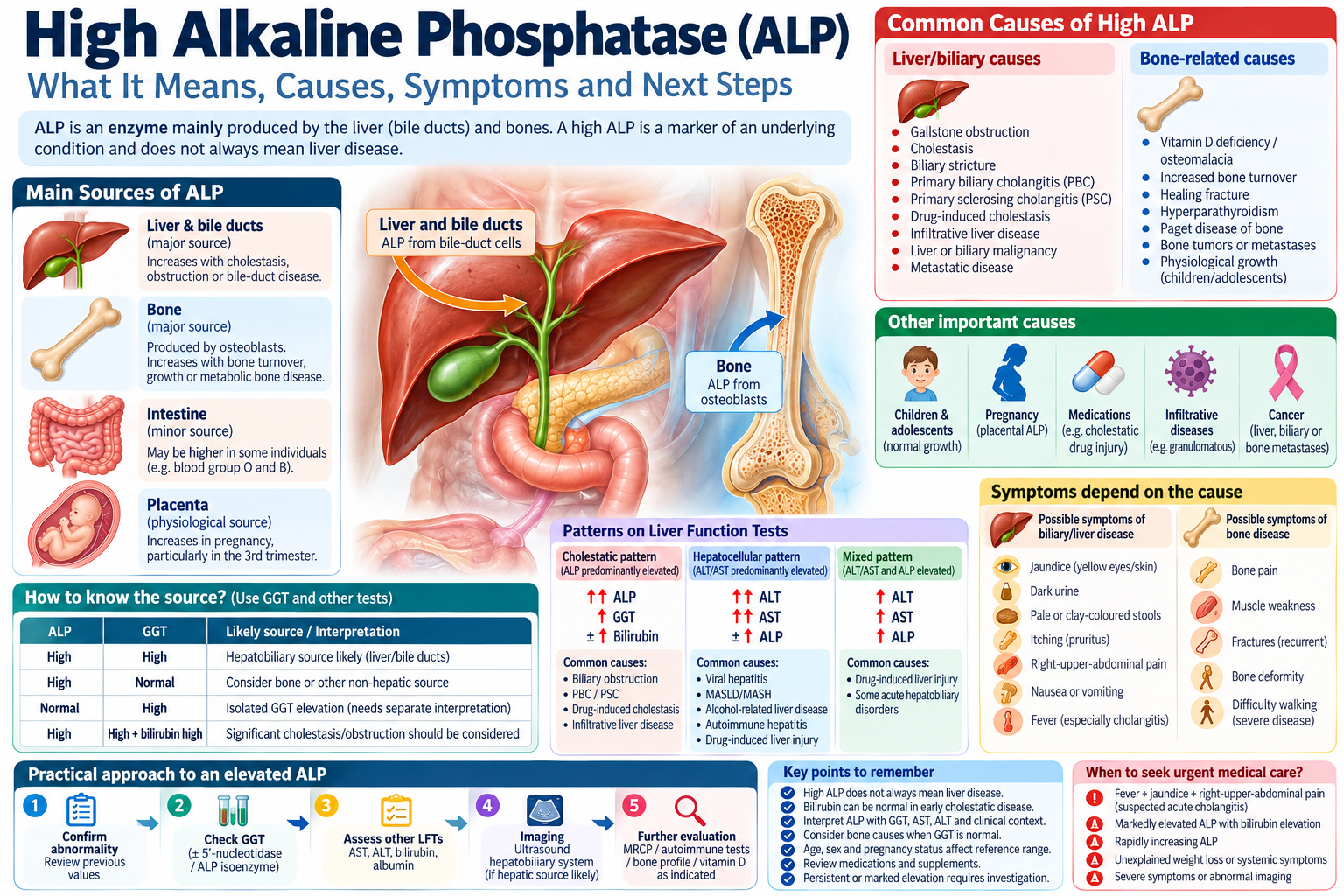

Alkaline phosphatase (ALP) is an enzyme commonly included in liver function tests (LFTs). A high ALP level is often associated with liver or bile-duct disease, but ALP is not exclusively a liver enzyme. It is also produced by bone and, to a lesser extent, by the intestine and placenta.
Therefore, an elevated ALP should not automatically be interpreted as “liver damage.” The important clinical question is:
Where is the increased ALP coming from—liver/bile ducts or bone?
Understanding the source, degree of elevation, associated liver tests and clinical symptoms is essential for correct interpretation.
What Is Alkaline Phosphatase?
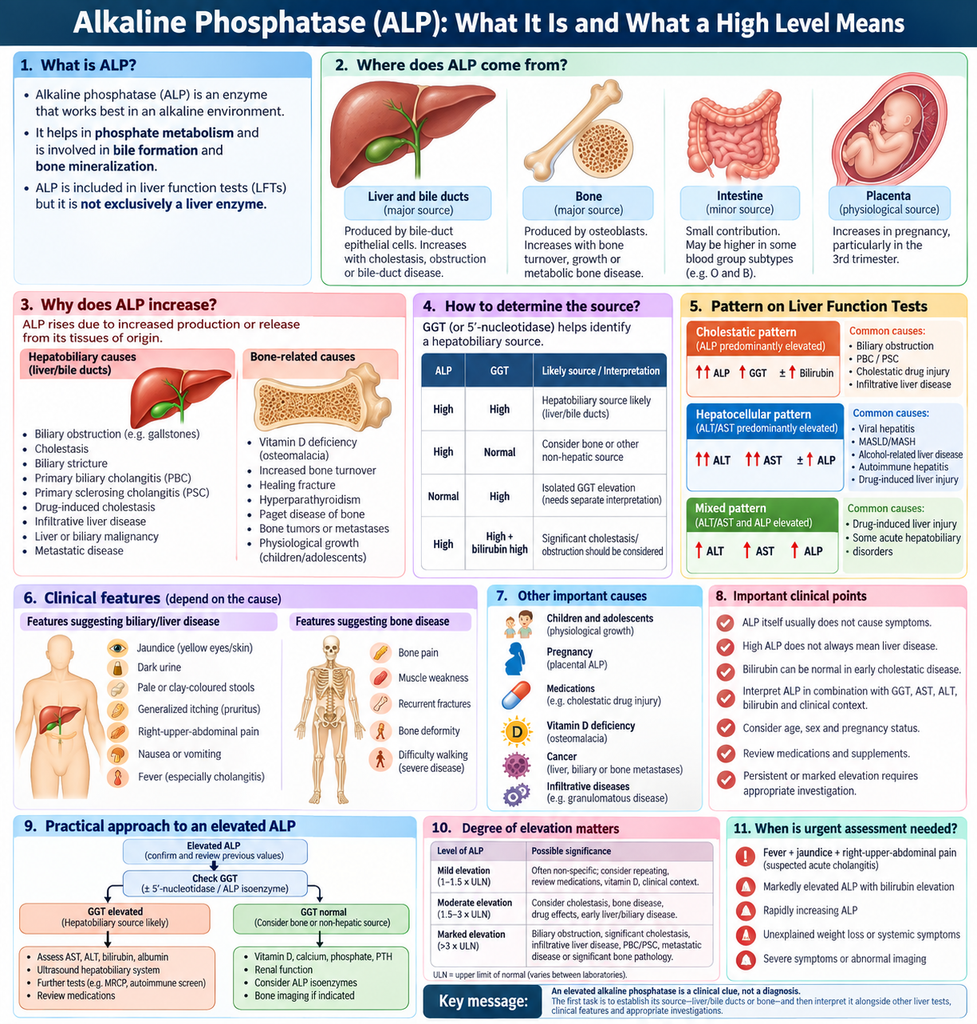
Alkaline phosphatase is an enzyme that works best in an alkaline environment and is involved in several biological processes, particularly phosphate metabolism and bone mineralization.
The major sources of circulating ALP are:
- Liver and bile-duct epithelium
- Bone
- Placenta
- Intestine
In adults, liver and bone are the most clinically important sources.
Why Does ALP Increase?
ALP rises when there is increased production or release of the enzyme from its tissues of origin.
The two major categories are:
1. Hepatobiliary ALP elevation
The liver component of ALP is particularly associated with the bile ducts.
Conditions that interfere with bile flow can cause significant ALP elevation.
Common causes include:
- Gallstones causing bile-duct obstruction
- Cholestasis
- Biliary strictures
- Primary biliary cholangitis (PBC)
- Primary sclerosing cholangitis (PSC)
- Drug-induced cholestasis
- Infiltrative liver diseases
- Liver or biliary malignancy
- Metastatic disease involving the liver
2. Bone-related ALP elevation
Bone-forming cells called osteoblasts produce ALP.
Important causes include:
- Vitamin D deficiency and osteomalacia
- Increased bone turnover
- Healing fractures
- Hyperparathyroidism
- Paget disease of bone
- Some bone tumors or metastases
High ALP Does Not Always Mean Liver Disease
This is one of the most important points when interpreting an LFT.
A patient may have:
High ALP + normal ALT + normal AST + normal bilirubin
and still have a non-hepatic cause, particularly a bone-related cause.
Therefore, ALP should be interpreted in combination with GGT, AST, ALT, bilirubin and the clinical context.
How Can We Determine Whether ALP Is Coming From the Liver?
The Role of GGT
Gamma-glutamyl transferase (GGT) is useful in determining whether an elevated ALP is likely to be hepatobiliary in origin.
A practical interpretation is:
| ALP | GGT | Possible interpretation |
|---|---|---|
| High | High | Hepatobiliary source is likely |
| High | Normal | Consider bone or another non-hepatic source |
| Normal | High | Isolated GGT elevation requires separate interpretation |
| High | High + bilirubin high | Significant cholestasis/obstruction should be considered |
GGT is helpful but is not completely specific, so results should always be interpreted in context.
When the source remains uncertain, ALP isoenzyme testing or 5′-nucleotidase may be useful.
High ALP and Liver Function Tests: Understanding the Pattern
Rather than looking at ALP in isolation, clinicians should assess the overall biochemical pattern.
Cholestatic Pattern
Typically:
ALP disproportionately elevated compared with AST/ALT
There may also be an increase in GGT and bilirubin.
Possible causes include:
- Gallstone obstruction
- Biliary stricture
- PBC
- PSC
- Cholestatic drug injury
- Infiltrative liver disease
Hepatocellular Pattern
Here:
AST and ALT are disproportionately elevated compared with ALP.
Common causes include:
- Viral hepatitis
- Metabolic dysfunction-associated steatotic liver disease (MASLD)
- Alcohol-related liver disease
- Autoimmune hepatitis
- Drug-induced liver injury
- Ischemic liver injury
Mixed Pattern
Both transaminases and ALP are significantly elevated.
This pattern can occur with several conditions, including drug-induced liver injury and some acute hepatobiliary disorders.
In formal assessment, clinicians may use the R-ratio:
R = (ALT ÷ ALT upper limit of normal) ÷ (ALP ÷ ALP upper limit of normal)
Generally:
- R >5: hepatocellular pattern
- R <2: cholestatic pattern
- R 2–5: mixed pattern
Can ALP Become High Before Bilirubin?
Yes.
In some cholestatic and biliary disorders, ALP and GGT can become abnormal before bilirubin rises significantly.
Therefore:
A normal bilirubin level does not completely exclude early or partial biliary disease.
This is particularly relevant when ALP is persistently or significantly elevated.
What Symptoms Can Occur With High ALP?
ALP itself usually does not cause symptoms.
The symptoms arise from the underlying condition.
Symptoms suggesting biliary/liver disease
- Jaundice
- Dark urine
- Pale or clay-colored stools
- Generalized itching
- Right-upper-abdominal discomfort
- Nausea or vomiting
- Fever, particularly when infection is present
Symptoms suggesting bone disease
- Bone pain
- Muscle weakness
- Recurrent fractures
- Bone deformity
- Difficulty walking in severe metabolic bone disease
Some patients with an elevated ALP may have no symptoms at all, especially when the abnormality is discovered incidentally during routine blood testing.
How High Is “High” ALP?
The degree of elevation is clinically important.
A small elevation may occur because of:
- Biological variation
- Mild cholestasis
- Vitamin D deficiency
- Medication effects
- Physiological variation
A marked or progressive elevation requires more careful investigation, particularly when associated with elevated GGT, bilirubin or symptoms.
The actual interpretation should be based on the laboratory’s reference range, because reference intervals vary between laboratories and testing methods.
Important Non-Liver Causes of High ALP
When GGT is normal or liver disease is not otherwise supported, bone and metabolic causes should be considered.
Useful investigations may include:
- 25-OH Vitamin D
- Calcium
- Phosphate
- Parathyroid hormone (PTH)
- Renal function
- ALP isoenzymes when appropriate
Vitamin D deficiency is an especially common and clinically relevant cause of increased bone turnover and ALP elevation in some populations.
Physiological Causes of Elevated ALP
Not every elevation represents disease.
ALP may physiologically increase in:
Children and adolescents
Growing bones have high osteoblastic activity, so ALP can be considerably higher than adult reference ranges.
Pregnancy
Placental ALP contributes to circulating ALP, particularly during later pregnancy.
Therefore, age, sex and pregnancy status must be considered before labelling an ALP result abnormal.
Drugs Can Also Increase ALP
Medication history is an important part of the evaluation.
Several medications can produce cholestatic or mixed liver injury, resulting in an increased ALP.
When an unexpected elevation occurs, clinicians should review:
- Prescription medications
- Over-the-counter drugs
- Herbal preparations
- Nutritional supplements
- Recently started medications
The timing of medication initiation and the timing of ALP elevation can provide important clues.
When Is Imaging Required?
If the ALP elevation appears to be hepatobiliary in origin, ultrasound of the hepatobiliary system is often an important initial investigation.
It can help identify:
- Gallstones
- Bile-duct dilatation
- Gallbladder abnormalities
- Structural biliary disease
- Liver lesions
Depending on the clinical situation, further evaluation may include MRCP, CT, MRI, autoimmune testing or other specialized investigations.
Persistent ALP Elevation: Conditions That Should Be Considered
Persistent unexplained hepatobiliary ALP elevation may warrant evaluation for chronic cholestatic diseases such as:
Primary Biliary Cholangitis (PBC)
Often presents with a cholestatic biochemical pattern. Antimitochondrial antibody (AMA) testing is an important component of evaluation.
Primary Sclerosing Cholangitis (PSC)
A chronic disease involving the bile ducts. MRCP may be required to assess the biliary tree.
Infiltrative Liver Disease
Examples include certain granulomatous diseases and malignant infiltration.
Persistent unexplained ALP elevation therefore deserves a structured clinical evaluation rather than simply repeating the LFT indefinitely.
ALP and Cancer: Does a High ALP Mean Cancer?
No.
An elevated ALP does not by itself diagnose cancer.
However, significant unexplained or progressively increasing ALP, particularly when accompanied by:
- Unintentional weight loss
- Persistent abdominal pain
- Jaundice
- Abnormal imaging
- Other abnormal laboratory findings
may require evaluation for hepatic infiltration, biliary malignancy or bone disease, depending on the clinical context.
When Is an Elevated ALP an Emergency?
Most isolated ALP elevations are not medical emergencies.
However, urgent assessment is appropriate when significant ALP elevation occurs with symptoms suggesting acute biliary infection or obstruction.
Particularly concerning is the combination of:
Fever + jaundice + right-upper-quadrant abdominal pain
This can indicate acute cholangitis, which requires prompt medical evaluation.
Practical Clinical Approach to High ALP
A useful approach is:
Elevated ALP
↓
Step 1: Confirm the abnormality
Review previous ALP values and laboratory reference range.
↓
Step 2: Determine the source
Check:
GGT ± 5′-nucleotidase / ALP isoenzyme
↓
If hepatic source is likely
Assess:
- AST
- ALT
- Bilirubin
- GGT
- Albumin
- INR when clinically appropriate
↓
Ultrasound hepatobiliary system when indicated.
↓
Depending on findings:
- MRCP
- Autoimmune testing
- Medication review
- Further liver evaluation
If bone source is suspected
Consider:
- Vitamin D
- Calcium
- Phosphate
- PTH
- Renal function
- Bone-specific ALP/ALP isoenzymes where appropriate
- Imaging when clinically indicated
Key Takeaways
High ALP does not automatically mean liver damage.
The most important clinical principles are:
- ALP comes mainly from liver/bile ducts and bone.
- GGT helps determine whether an elevated ALP is likely hepatobiliary.
- ALP + GGT elevation suggests a hepatobiliary source, but clinical context remains essential.
- High ALP with normal GGT should prompt consideration of bone and other non-hepatic causes.
- Bilirubin can remain normal in early or partial cholestatic disease.
- Vitamin D deficiency and other metabolic bone disorders can cause elevated ALP.
- Children, adolescents and pregnant women can have physiological ALP elevations.
- Persistent or marked unexplained elevation requires appropriate investigation.
- Ultrasound is often an important first imaging study when hepatic/biliary origin is suspected.
- ALP is a marker of an underlying process—it is not itself the disease.
Bottom Line
An elevated alkaline phosphatase should be interpreted as a clinical clue, not a diagnosis. The first task is to establish its source—liver/bile ducts versus bone—and then interpret it alongside GGT, AST, ALT, bilirubin and the patient’s symptoms and clinical history.
A structured approach prevents two common mistakes: assuming every high ALP represents liver disease and overlooking significant biliary or bone pathology.