

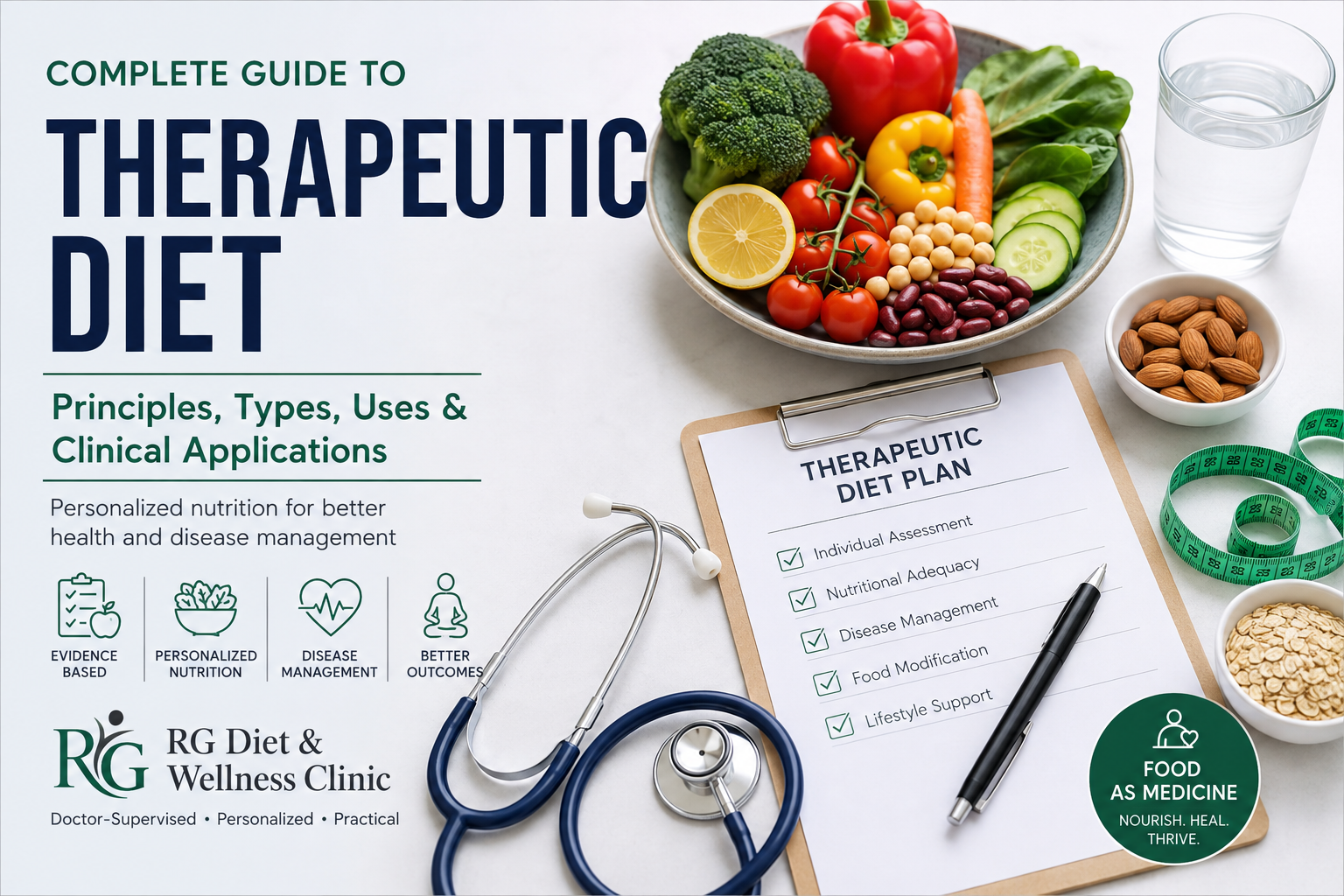

A therapeutic diet is a scientifically planned modification of the normal diet used to support the prevention, management or treatment of disease. It is an important part of clinical nutrition and Medical Nutrition Therapy (MNT).
A therapeutic diet is not simply a list of foods to avoid. It involves modifying the quality, quantity, consistency, nutrient composition, meal pattern or food selection according to the individual’s clinical requirements. The basic principle is to use the normal diet as the foundation and modify it appropriately for the person’s disease and nutritional needs.
For patients requiring individualized nutrition assessment and clinical diet planning, see Medical Nutrition Therapy at RG Wellness Clinic.
What Is a Therapeutic Diet?
A therapeutic diet is a modified normal diet designed to meet the nutritional and clinical requirements of a person with a disease or health condition.
Depending on the condition, modifications may involve:
- Energy or calorie intake
- Carbohydrate
- Protein
- Fat
- Sodium
- Fibre
- Vitamins and minerals
- Fluid
- Food consistency
- Meal frequency
- Specific food exclusions
The uploaded therapeutic-diet material emphasizes that modified diets should be based on the normal diet while being adapted to the requirements of the sick individual.
A healthy dietary pattern should also remain nutritionally adequate, balanced, moderate and diverse. These four principles are emphasized by the World Health Organization’s healthy-diet guidance.
Objectives of Therapeutic Diet
The major objectives of diet therapy include:
1. Maintain nutritional status
The diet should provide appropriate energy and nutrients according to the individual’s requirements.
2. Correct nutritional deficiencies
Disease, poor intake, malabsorption or dietary restrictions can contribute to nutrient deficiencies. Therapeutic planning should address these when clinically appropriate.
3. Support the affected body or organ
Dietary modification may reduce the nutritional or metabolic burden associated with certain diseases.
4. Adjust nutrient intake to metabolic capacity
The body may not digest, absorb, transport or metabolize nutrients normally during illness. The diet may therefore require appropriate modification.
5. Support appropriate weight management
Diet therapy can be used when weight gain or weight reduction is clinically appropriate.
These objectives are specifically described in the uploaded therapeutic-diet teaching material.
Principles of Therapeutic Diet Planning
A therapeutic diet should be individualized rather than automatically prescribed solely on the basis of a diagnosis.
1. Consider the Type of Disease
The dietary prescription should correspond to the disease and its clinical requirements.
For example:
- Carbohydrate modification may be required in diabetes.
- Sodium modification may be appropriate in hypertension or selected cardiac and renal conditions.
- Fibre modification may be necessary in selected gastrointestinal conditions.
- Purine modification may be relevant in gout.
The uploaded source specifically emphasizes that the diet should be planned according to the disease because inappropriate modification may be counterproductive.
For disease-specific nutrition planning, explore the RG Wellness Diet Plans.
2. Consider the Duration of Disease
The nutritional approach may differ between acute and chronic illness.
For long-term conditions, dietary variety is important. Repeating the same restricted diet indefinitely can lead to monotony and poor adherence. The source material specifically emphasizes variation in long-duration dietary planning.
3. Consider the Patient’s Usual Food Pattern
A therapeutic diet should take into account:
- Usual food intake
- Meal timing
- Food preferences
- Food dislikes
- Cooking methods
- Cultural practices
- Food availability
- Economic circumstances
- Lifestyle and occupation
This makes the diet more practical and sustainable.
4. Consider Patient Acceptability
Taste, texture, appearance, variety and cultural acceptability influence whether a patient can follow a diet consistently.
A technically appropriate diet that the patient cannot realistically follow is unlikely to produce good long-term results.
Four Important Attributes of a Therapeutic Diet
An effective therapeutic diet should aim for:
Adequacy
The diet should provide the nutrients and energy required by the individual.
Accuracy
The modifications should correspond to the actual clinical requirement.
Economy
The plan should be practical and financially feasible.
Palatability
The diet should be acceptable in taste, texture and presentation.
These principles are consistent with the therapeutic-diet teaching material, which emphasizes nutritional adequacy, patient acceptance, variety and practical dietary planning.
How Are Therapeutic Diets Modified?
Therapeutic diets may be modified in quality and quantity. The uploaded material describes quantitative modifications as well as qualitative modifications such as changes in consistency, meal arrangement and food exclusion.
Energy Modification
Energy intake may be increased or reduced depending on nutritional status and clinical requirements.
A higher-energy diet may be considered in selected situations involving:
- Significant undernutrition
- Increased metabolic requirements
- Selected malabsorption states
- Other clinically indicated conditions
A lower-energy diet may be appropriate for selected patients requiring weight management.
The exact energy prescription should be individualized.
Carbohydrate Modification
Carbohydrate intake may be modified according to the disease and clinical objective.
For example, carbohydrate management is an important component of nutrition therapy for diabetes.
However, carbohydrate quality also matters. The WHO recommends that carbohydrates should primarily come from sources such as whole grains, vegetables, fruits and pulses.
Patients looking for condition-specific nutrition information can explore the RG Wellness Diabetes Diet Plan.
Protein Modification
Protein requirements depend on:
- Age
- Body weight
- Nutritional status
- Kidney function
- Liver function
- Physical activity
- Disease severity
- Metabolic stress
The therapeutic-diet source describes both higher- and lower-protein modifications in selected clinical conditions.
Therefore, high-protein and low-protein diets should not be prescribed simply because a patient has a particular disease. The individual’s clinical and nutritional assessment should guide the prescription.
See the High Protein Diet Plan for general educational information.
Fat Modification
Dietary fat may be modified according to the individual’s nutritional and clinical requirements.
Possible approaches include:
- Reducing excessive total fat
- Improving fat quality
- Reducing saturated fat
- Avoiding industrial trans fats
- Adjusting fat intake in selected gastrointestinal or hepatic conditions
WHO recommends emphasizing healthier unsaturated fats while limiting saturated and trans fats.
For patients who require a reduced-fat approach, see the Low Fat Diet Plan.
Sodium Modification
Sodium restriction may be required in selected clinical situations, particularly when blood pressure, fluid balance, cardiac status or kidney function makes sodium reduction appropriate.
The uploaded therapeutic-diet material specifically identifies sodium restriction in hypertension, cardiac failure and selected kidney conditions.
See the Low Sodium Diet Plan for practical dietary guidance.
For broader healthy-diet principles, WHO also provides current guidance on sodium and overall dietary quality.
Fibre Modification
Fibre may be increased or reduced depending on the clinical situation.
The uploaded material describes fibre-rich diets for constipation and lower-fibre approaches for selected gastrointestinal disorders.
For suitable patients, fibre-rich foods may include:
- Vegetables
- Fruits
- Pulses
- Whole grains
- Nuts and seeds
However, fibre recommendations should be individualized in gastrointestinal disorders.
Explore the High Fibre Diet Plan for general educational guidance.
Modification of Minerals and Vitamins
Therapeutic diets may involve modifications in minerals and vitamins.
Examples described in the source include:
- Calcium modification
- Phosphorus modification
- Sodium restriction
- Vitamin supplementation where required
The source specifically notes that mineral and vitamin modifications may be important in selected clinical conditions.
Such restrictions or supplementation should be based on the patient’s clinical condition and, where appropriate, laboratory findings.
Modification of Food Consistency
Not all therapeutic diets involve changing nutrient composition.
Sometimes the physical consistency of food needs modification.
Examples include:
- Liquid diets
- Soft diets
- Modified-texture diets
- Increased meal frequency
- Other consistency modifications
The source describes consistency modification as one of the important forms of therapeutic diet modification.
Therapeutic Diets for Different Medical Conditions
A therapeutic diet can be used as part of comprehensive management for many conditions.
Diabetes
Nutrition planning may focus on:
- Appropriate carbohydrate intake
- Meal distribution
- Portion control
- Dietary quality
- Fibre-rich foods where appropriate
- Weight management where appropriate
- Coordination with medications and physical activity
For diabetes-specific clinical recommendations, see the RSSDI Guidelines & Position Statements, which includes Indian clinical recommendations and consensus statements.
For patient-oriented nutrition information, see the RG Wellness Diabetes Diet Plan.
Hypertension
A therapeutic dietary approach for hypertension may emphasize:
- Appropriate sodium intake
- Vegetables and fruits
- Whole grains
- Pulses
- Appropriate protein sources
- Healthier fats
- Overall dietary quality
See the RG Wellness Hypertension Diet Plan.
Kidney Disease
Nutrition management in kidney disease may require individualized consideration of:
- Protein
- Sodium
- Potassium
- Phosphorus
- Fluid
- Energy
The appropriate prescription depends on kidney function, disease stage, laboratory findings, nutritional status and whether dialysis is being received.
See the Kidney Disease Diet Plan and, where relevant, the Dialysis Diet Plan.
Liver Disease
Nutrition therapy for liver disease depends on the underlying diagnosis and severity.
Potential considerations include:
- Adequate energy intake
- Appropriate protein intake
- Fat quality
- Sodium management where clinically indicated
- Prevention or management of malnutrition
- Appropriate management of associated metabolic conditions
See the Liver Disease Diet Plan and Fatty Liver Diet Plan.
Gout and High Uric Acid
Dietary management may involve attention to:
- Purine-rich foods
- Alcohol intake
- Sugar-sweetened beverages
- Hydration
- Body weight
- Overall dietary quality
The uploaded therapeutic-diet source identifies low-purine dietary modification as one therapeutic approach used in gout.
High Cholesterol and Cardiovascular Health
Nutrition planning may emphasize:
- Better fat quality
- Reduction of excessive saturated fat
- Increased intake of suitable plant foods
- Appropriate fibre intake
- Weight management where appropriate
- Overall dietary pattern
Explore the High Cholesterol Diet Plan and Heart Healthy Diet Plan.
Therapeutic Diets Should Be Individualized
Two people with the same diagnosis may not require identical diets.
Their requirements may differ because of:
- Age
- Sex
- Body weight
- Physical activity
- Disease severity
- Medication
- Kidney function
- Liver function
- Laboratory results
- Food preferences
- Cultural eating pattern
- Meal timing
- Occupation
- Economic circumstances
Therefore, the best therapeutic diet is not necessarily the most restrictive diet. It is the diet that appropriately addresses the clinical requirement while remaining nutritionally adequate, practical and sustainable.
For individualized nutrition planning, visit Personalized Diet Plans at RG Wellness Clinic.
Therapeutic Diet vs Normal Diet
| Normal Diet | Therapeutic Diet |
|---|---|
| Designed for general nutritional requirements | Modified according to clinical requirements |
| Usually no disease-specific restrictions | May require specific modifications |
| General dietary pattern | Individualized dietary prescription |
| Focuses on maintaining health | May support disease management and recovery |
| Based on usual dietary needs | Based on usual diet plus required modifications |
The uploaded material emphasizes that the normal diet should form the basis for therapeutic modification rather than creating an entirely unrelated dietary pattern.
Therapeutic Diet and Medical Nutrition Therapy
A therapeutic diet is best understood as part of a broader Medical Nutrition Therapy process.
A professional nutrition-care approach may involve:
Assessment → Nutrition Diagnosis → Intervention → Monitoring → Evaluation
The assessment may include:
- Medical history
- Anthropometric measurements
- Dietary intake
- Lifestyle
- Medication and supplement use
- Laboratory findings
- Food preferences
- Nutritional risk
The intervention is then individualized and monitored over time.
For more information, visit Medical Nutrition Therapy at RG Wellness Clinic.
Indian Dietary Guidance and Therapeutic Nutrition
For an Indian population, dietary planning should also consider local foods, cultural practices, meal patterns and food availability.
The ICMR-National Institute of Nutrition Dietary Guidelines for Indians 2024 provides national dietary guidance for India. ICMR-NIN Dietary Guidelines for Indians 2024
These national recommendations can provide a useful foundation for healthy dietary patterns, while therapeutic diets still require individual clinical modification according to disease and nutritional status.
How a Professional Therapeutic Diet Is Planned
A structured clinical approach can be summarized as:
Step 1 — Assess
Review medical history, dietary intake, anthropometry, lifestyle and available investigations.
Step 2 — Identify the Nutrition Problem
Determine the major nutrition-related issues requiring intervention.
Step 3 — Define the Clinical Goal
Examples include:
- Improving dietary quality
- Supporting glycaemic management
- Managing sodium intake
- Correcting nutritional inadequacy
- Supporting healthy weight management
Step 4 — Design the Diet
Modify nutrients, portions, food choices, meal timing and consistency according to the individual’s requirements.
Step 5 — Educate
Explain what to eat, how much to eat, when to eat and how the recommendations fit into everyday life.
Step 6 — Monitor
Review adherence, symptoms, weight, laboratory findings and other relevant outcomes.
Step 7 — Adjust
Therapeutic diets may need modification as the patient’s clinical status changes.
Related RG Wellness Diet Plans
If you are looking for condition-specific nutrition guidance, explore:
- Diabetes Diet Plan
- Hypertension Diet Plan
- High Cholesterol Diet Plan
- Kidney Disease Diet Plan
- Liver Disease Diet Plan
- Fatty Liver Diet Plan
- Heart Healthy Diet Plan
- Low Sodium Diet Plan
- High Fibre Diet Plan
- Low Fat Diet Plan
- High Protein Diet Plan
- Personalized Diet Plans
Your website structure places Therapeutic Diets under Medical Nutrition Therapy, making this article suitable as a pillar article supporting these condition-specific diet pages.
Key Takeaways
- A therapeutic diet is a modified normal diet designed for a specific clinical requirement.
- It should maintain nutritional adequacy while addressing disease-related needs.
- The diet should consider the type and duration of disease, food history, patient preferences, lifestyle and practical circumstances.
- Energy, carbohydrate, protein, fat, fibre, sodium, vitamins, minerals and food consistency may require modification.
- The most appropriate diet is not necessarily the most restrictive diet.
- Individualization is essential.
- Therapeutic nutrition should be monitored and adjusted according to clinical progress.
Frequently Asked Questions
What is a therapeutic diet?
A therapeutic diet is a modification of the normal diet designed to meet the nutritional and clinical requirements of a person with a disease or health condition.
Is a therapeutic diet the same for everyone with the same disease?
No. Dietary requirements vary according to disease severity, medications, laboratory findings, nutritional status, lifestyle, food preferences and other individual factors.
Can a therapeutic diet replace medicines?
A therapeutic diet generally forms part of comprehensive medical care and should not be assumed to replace prescribed medication. Medication changes should be made by the treating clinician.
Who can benefit from therapeutic diet planning?
People with conditions such as diabetes, hypertension, kidney disease, liver disease, cardiovascular disease, gastrointestinal disorders, gout, nutritional deficiencies and weight-related conditions may require individualized dietary management.
Why is patient preference important?
A diet that fits the patient’s food habits, culture, budget, schedule and preferences is generally more practical to follow than an unnecessarily restrictive diet.
Is a therapeutic diet always restrictive?
No. Therapeutic diets may involve restriction, addition, substitution, modification of food consistency, rearrangement of meals or other dietary changes depending on the clinical requirement.
Medical Disclaimer
This article is intended for general educational and nutritional information and is not a substitute for individualized medical assessment.
Therapeutic diets should be planned according to the patient’s medical history, nutritional assessment, medications, laboratory findings and clinical condition. Patients with kidney disease, liver disease, heart disease, diabetes or other significant medical conditions should obtain appropriate professional medical and nutrition advice before making major dietary changes.
