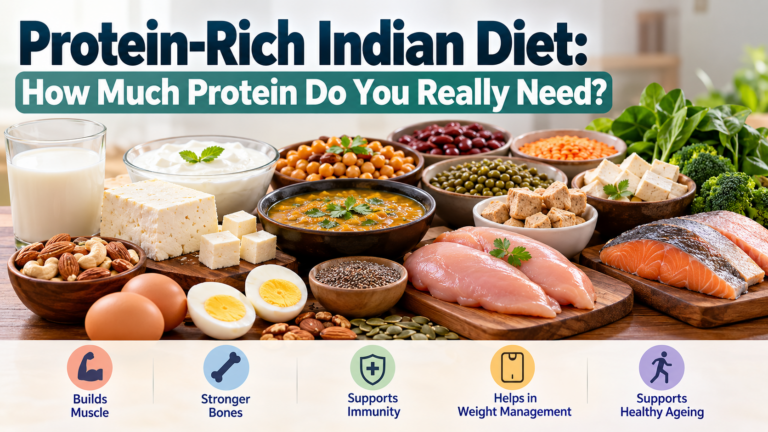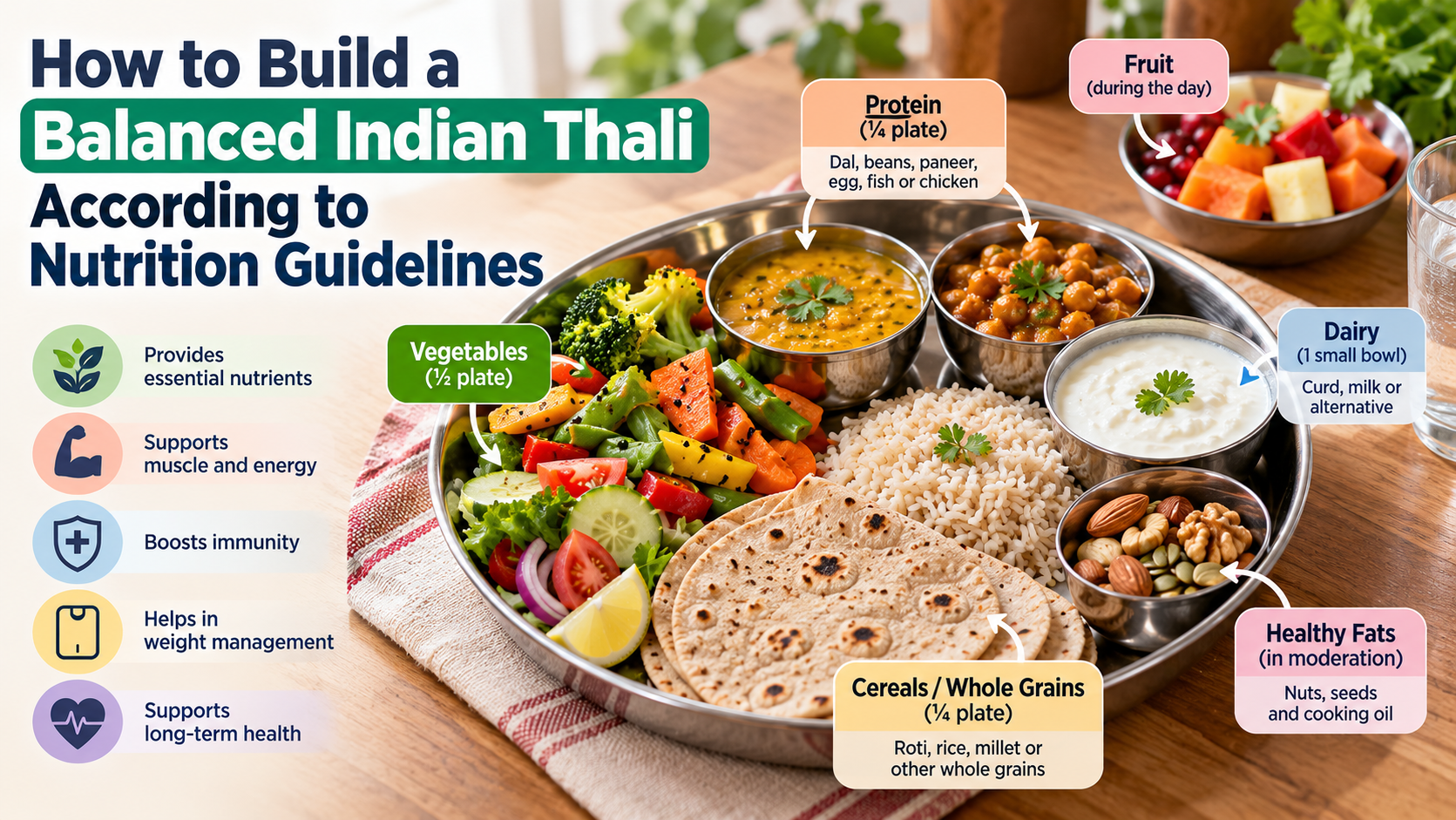

A balanced Indian thali does not need to be complicated. It should provide vegetables, adequate protein, appropriate portions of cereals or other carbohydrate foods, dairy or alternatives, healthy fats and fruit across the day.
The ICMR–National Institute of Nutrition (NIN) Dietary Guidelines for Indians 2024 emphasize dietary diversity and a balanced intake from multiple food groups. Its “My Plate for the Day” provides a practical framework for a 2,000-kcal diet. Importantly, this is a whole-day food-group model—not a prescription for the quantity on one lunch or dinner plate.
The World Health Organization similarly recommends diets rich in vegetables, fruits, legumes, nuts and whole grains while limiting excess salt, free sugars and unhealthy fats.
What Should a Balanced Indian Thali Contain?
A practical main meal can be built around five components:
- Vegetables – make them the largest part of the meal.
- Protein – dal, beans, chana, rajma, soy, tofu, paneer, curd, eggs, fish or lean meat.
- Cereals or other carbohydrate foods – roti, rice, millet or other whole grains.
- Dairy or alternative – curd, milk or a suitable alternative.
- Healthy fats – modest amounts of oil, nuts or seeds.
Fruit can be included elsewhere in the day’s diet.
The exact portions should depend on age, body size, physical activity, health conditions and energy requirements.
What Does ICMR-NIN Recommend?
The ICMR-NIN 2024 model for a 2,000-kcal daily diet includes approximately:
| Food group | Approximate daily quantity |
|---|---|
| Cereals & millets | 250 g |
| Vegetables | 400 g |
| Fruits | 100 g |
| Pulses, eggs & flesh foods | 85 g |
| Nuts & seeds | 35 g |
| Milk/curd | 300 mL |
| Fats & oils | 27 g |
These are daily quantities, not quantities to place on one plate. Individual requirements vary.
ICMR-NIN also recommends obtaining a substantial proportion of cereal intake from whole grains, including millets.
A Simple Indian Plate Model
For a practical lunch or dinner:
½ plate: Vegetables
Choose seasonal vegetables such as:
- Lauki
- Tori
- Bhindi
- Gobi
- Beans
- Cabbage
- Baingan
- Palak and other leafy vegetables
- Mixed vegetables
Salad can complement the vegetable portion.
¼ plate: Protein
Choose one or more appropriate sources:
Vegetarian: dal, chana, rajma, lobia, soy, tofu, paneer or curd.
Non-vegetarian: egg, fish or chicken.
The required quantity depends on the individual’s total daily protein requirement.
¼ plate: Cereal or other carbohydrate
Examples:
- Whole-wheat roti
- Rice
- Millet
- Other whole grains
This ½–¼–¼ plate model is a practical meal-planning tool, not a direct ICMR-NIN prescription that every Indian meal must follow exactly.
Examples of Balanced Indian Meals
Vegetarian
Roti + dal + mixed vegetable sabzi + salad + curd
Rice-based
Moderate rice + dal/sambar + vegetables + curd
Non-vegetarian
Roti or rice + fish/chicken + vegetables + salad + curd
The same principles can be adapted to regional Indian cuisines.
Does Rice Have to Be Avoided?
No.
Rice can be part of a healthy diet. The important considerations are:
- Portion size
- Overall carbohydrate intake
- Type of rice
- Amount of vegetables and protein accompanying it
- Total calorie intake
A large serving of rice eaten alone is very different from a moderate serving combined with vegetables, dal and other protein-rich foods.
Similarly, roti is not automatically healthier than rice. The overall dietary pattern and portions matter.
What About Millets?
Millets can be nutritious whole-grain choices and can contribute variety to the diet.
However, there is no requirement for everyone to completely replace rice or wheat with millets.
The choice should consider:
- Dietary preference
- Availability
- Cultural eating pattern
- Energy requirements
- Tolerance
- Medical conditions
ICMR-NIN recommends that at least half of cereal intake come from whole grains, including millets where appropriate.
Protein: Don’t Let the Thali Become Cereal-Heavy
A common Indian meal may contain plenty of roti or rice but relatively little protein.
Include an appropriate protein source such as:
- Dal
- Chana
- Rajma
- Soy/tofu
- Paneer
- Curd
- Eggs
- Fish
- Chicken
Protein requirements vary substantially with age, body weight, physical activity and medical conditions.
People with chronic kidney disease should not independently adopt a high-protein diet without appropriate medical or dietetic advice.
What About Ghee, Oil, Pickle and Papad?
These foods do not necessarily need to be completely eliminated, but quantity matters.
Ghee and oil
Both are energy-dense. Excessive use can substantially increase calorie intake.
Pickle and papad
These can contribute significant sodium, particularly when consumed frequently or in large quantities.
WHO recommends limiting salt intake to less than 5 g per day in adults.
People with hypertension, kidney disease or heart failure may need more individualized sodium restriction.
What Should Be Limited?
A balanced thali should not be dominated by:
- Deep-fried foods
- Large amounts of ghee or oil
- Sugary drinks
- Sweets and desserts
- Refined snacks
- Packaged ultra-processed foods
- Excessively salty foods
WHO recommends limiting free sugars, saturated fat, trans fat and sodium as part of a healthy dietary pattern.
How to Modify the Thali for Diabetes
People with diabetes do not automatically need to eliminate rice or roti.
A practical approach is to:
- Increase non-starchy vegetables
- Include adequate protein
- Control cereal portions
- Prefer higher-fiber carbohydrate sources
- Avoid sugar-sweetened beverages
- Limit refined and highly processed foods
Medication, glucose control, activity and total carbohydrate requirements should be considered when individualizing the meal plan.
How to Modify the Thali for Weight Loss
A balanced thali can support weight management when portions are appropriate.
Useful changes include:
- Increase vegetables
- Include adequate protein
- Reduce oversized rice/roti portions
- Measure cooking oil
- Limit fried foods
- Choose whole fruit instead of juice
- Reduce sugary beverages and frequent desserts
There is no need to eliminate a single Indian staple universally.
What About Children and Older Adults?
Children and adolescents
They need sufficient energy and nutrients for growth. Adult weight-loss portions should not simply be applied to children.
Older adults
Pay particular attention to:
- Adequate protein
- Calcium and vitamin D
- Hydration
- Fiber
- Appetite
- Muscle preservation
For an older person with poor appetite, nutrient density may be more important than simply increasing meal volume.
A Quick Balanced-Thali Checklist
Before eating, ask:
Vegetables: Have I included enough?
Protein: What is my main protein source?
Carbohydrate: Is my rice/roti portion appropriate?
Dairy: Have I included curd, milk or an alternative during the day?
Fat: How much oil, ghee, nuts or seeds am I consuming?
Salt: Am I adding large amounts of pickle, papad or salty packaged foods?
Sugar: Is there an unnecessary sweetened drink or dessert?
This simple checklist is often more useful than trying to follow a rigid menu.
The Bottom Line
A balanced Indian thali does not require expensive foods, imported ingredients or complicated calorie counting.
Build meals around:
Vegetables + adequate protein + appropriate cereal portions + suitable dairy/alternatives + moderate healthy fats.
Across the day, include whole fruits, nuts/seeds and a variety of foods from different food groups.
The ICMR-NIN My Plate for the Day provides a useful framework for dietary balance, while the practical plate model helps translate those principles into an individual meal.
The goal is not to make every Indian meal look identical. The goal is to create a varied dietary pattern with appropriate portions, adequate protein and vegetables, and limited excess salt, sugar, unhealthy fats and highly processed foods.
Frequently Asked Questions
What should a balanced Indian thali contain?
Vegetables, a protein source, an appropriate portion of roti/rice or another cereal, and preferably curd or another suitable dairy alternative. Fruit, nuts and seeds can be distributed throughout the day.
Is rice allowed in a balanced diet?
Yes. Portion size and what you eat with the rice are more important than eliminating rice completely.
Is roti healthier than rice?
Neither is universally healthier. The type, preparation, portion and overall diet matter.
Should vegetables occupy half the plate?
Using approximately half the meal for non-starchy vegetables is a useful practical strategy. It should not be presented as an exact ICMR-NIN requirement for every meal.
Can people with diabetes eat a normal Indian thali?
Yes, but carbohydrate portions and food choices may need to be individualized according to glucose control, medication, activity and energy requirements.
Is ghee healthy?
Ghee can be included in small amounts, but it is energy-dense and contributes saturated fat. Quantity matters.
Do I need to stop eating rice or wheat to lose weight?
No. Weight management depends primarily on overall energy intake, food quality, activity and adherence rather than eliminating one staple food.
References
- ICMR–National Institute of Nutrition. Dietary Guidelines for Indians 2024. Indian Council of Medical Research, Government of India.
- ICMR–National Institute of Nutrition. My Plate for the Day. Government of India.
- World Health Organization. Healthy Diet. WHO guidance on vegetables, fruits, legumes, nuts, whole grains, fats, free sugars and sodium.
- WHO/FAO. What are healthy diets? Joint statement by the Food and Agriculture Organization of the United Nations and WHO, 2024.