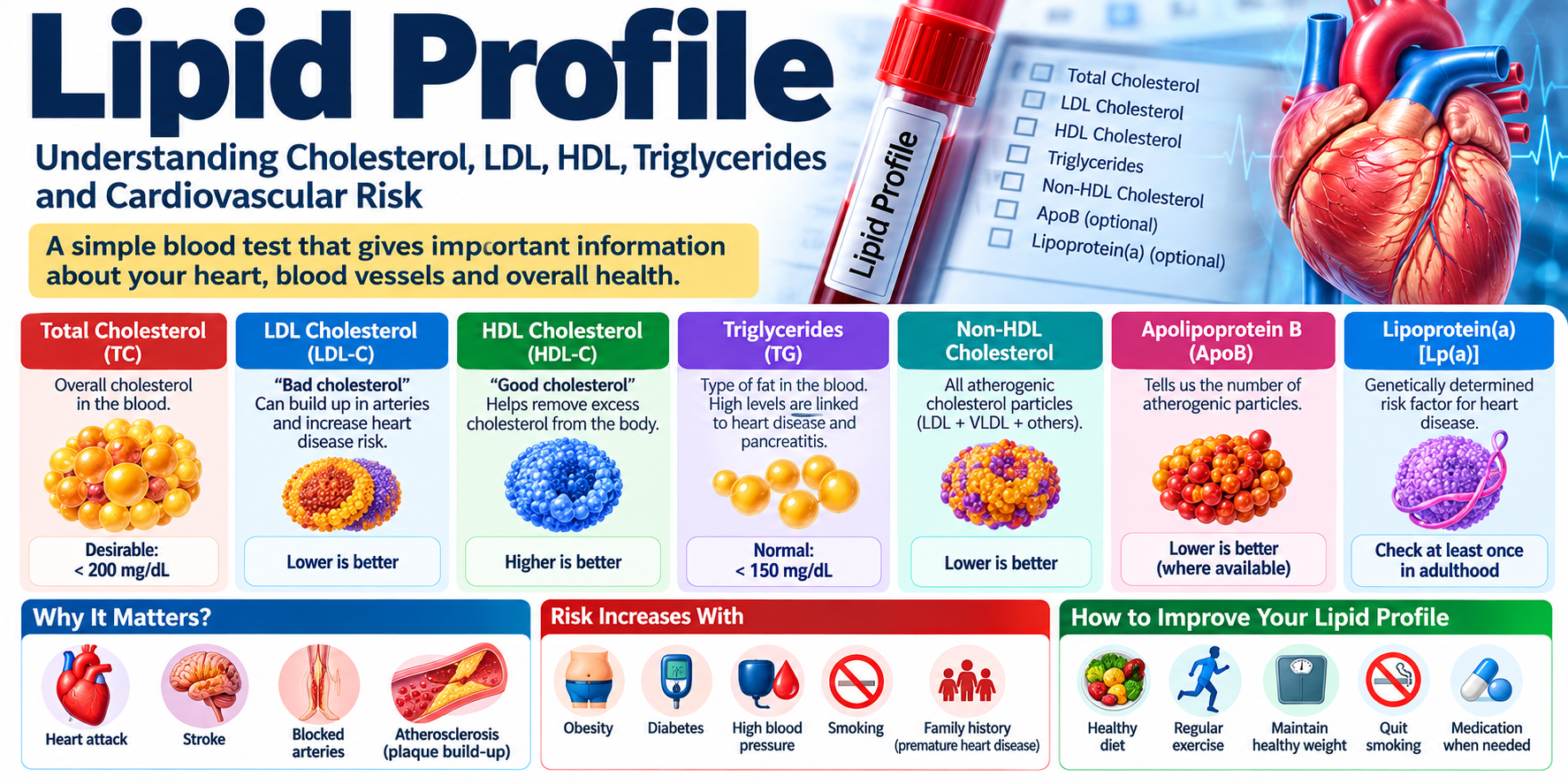

A lipid profile, also called a lipid panel, is a blood test used to assess cholesterol and triglycerides in the blood. It is one of the most commonly performed investigations for evaluating cardiovascular risk.
However, interpreting a lipid profile is more complicated than simply asking, “Is my cholesterol high?”
A complete interpretation considers LDL cholesterol, HDL cholesterol, triglycerides, non-HDL cholesterol, total cholesterol, and—when appropriate—Apolipoprotein B (ApoB) and Lipoprotein(a) [Lp(a)], together with blood pressure, diabetes, smoking, family history, kidney disease and other cardiovascular risk factors.
The 2026 ACC/AHA dyslipidemia guideline emphasizes earlier identification and treatment of abnormal lipids and a more individualized assessment of cardiovascular risk.
What Is a Lipid Profile?
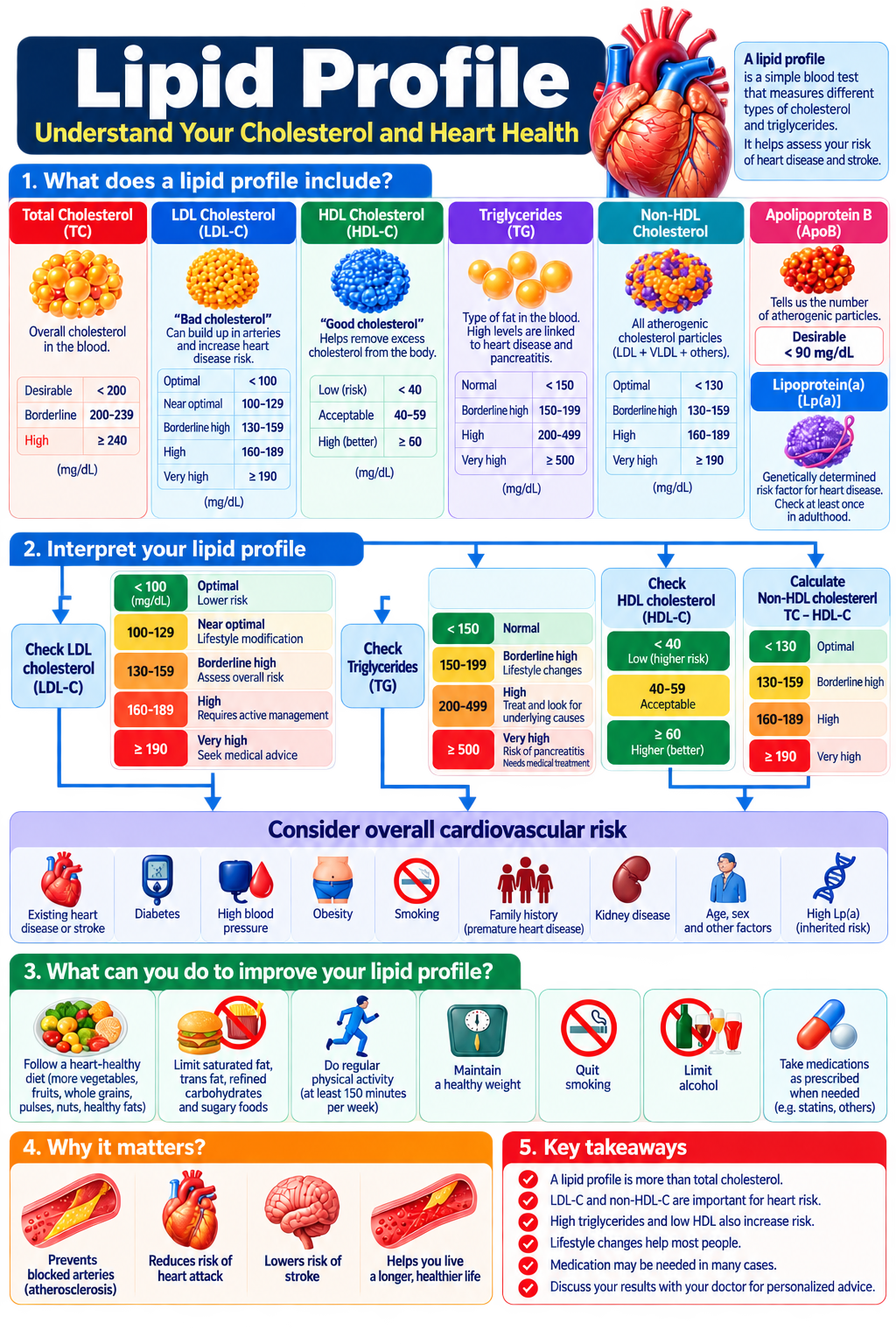
A standard lipid profile generally reports:
- Total cholesterol (TC)
- LDL cholesterol (LDL-C)
- HDL cholesterol (HDL-C)
- Triglycerides (TG)
Laboratories may also report:
- Non-HDL cholesterol
- VLDL cholesterol
- Cholesterol/HDL ratio
- LDL/HDL ratio
- ApoB, when specifically ordered
- Lipoprotein(a), when specifically ordered
A standard lipid panel provides a snapshot of the major circulating lipid fractions and helps clinicians assess cardiovascular risk.
What Is Cholesterol?
Cholesterol is a waxy, lipid-like substance that is essential for normal body function.
It is required for:
- Cell membranes
- Steroid hormone production
- Bile acid production
- Vitamin D metabolism
- Normal cellular function
The liver produces cholesterol, and dietary cholesterol also contributes to the body’s cholesterol pool.
The problem is not cholesterol itself. The concern arises when atherogenic lipoproteins remain elevated over time, allowing cholesterol-containing particles to contribute to plaque formation within arteries.
Understanding the Different Components of a Lipid Profile
1. Total Cholesterol
Total cholesterol (TC) represents the overall cholesterol carried in the blood.
A commonly used general classification is:
| Total cholesterol | General interpretation |
|---|---|
| <200 mg/dL | Desirable |
| 200–239 mg/dL | Borderline high |
| ≥240 mg/dL | High |
However, total cholesterol should not be interpreted in isolation and is not itself the primary treatment target.
For example:
A person with:
Total cholesterol = 220 mg/dL
may have a very different cardiovascular risk depending on whether the LDL is 120 mg/dL or 170 mg/dL and what the person’s other risk factors are.
The American Heart Association emphasizes that total cholesterol is a screening measure rather than a treatment target by itself.
2. LDL Cholesterol — The Major Atherogenic Cholesterol
LDL-C (low-density lipoprotein cholesterol) is often called “bad cholesterol.”
LDL particles can enter the arterial wall and contribute to atherosclerotic plaque formation.
Over many years, elevated LDL-C can increase the risk of:
- Coronary artery disease
- Heart attack
- Ischemic stroke
- Peripheral arterial disease
The relationship is particularly important because cumulative exposure to elevated LDL over the course of life matters.
The current ACC/AHA guideline therefore emphasizes earlier intervention and appropriate LDL-C lowering, particularly in people with increased cardiovascular risk.
Why LDL Is So Important
A useful way to think about LDL is:
The longer the arteries are exposed to elevated atherogenic lipoproteins, the greater the opportunity for atherosclerosis to develop.
Therefore, a moderately elevated LDL in a young person with a strong family history should not automatically be dismissed simply because the person has no symptoms.
Similarly, a substantially elevated LDL may require evaluation for familial hypercholesterolemia (FH), particularly when there is:
- Very high LDL-C
- Family history of premature coronary disease
- Known high cholesterol in multiple family members
- Premature cardiovascular disease in relatives
3. HDL Cholesterol — The “Good” Cholesterol
HDL-C (high-density lipoprotein cholesterol) has traditionally been called “good cholesterol.”
HDL participates in the transport of cholesterol from peripheral tissues toward the liver.
However, an important modern clinical concept is:
A high HDL level does not automatically cancel out the risk associated with high LDL or other atherogenic particles.
Therefore, treatment decisions should not be based simply on trying to increase HDL.
The American Heart Association notes that HDL is associated with cardiovascular protection, but cholesterol interpretation should consider the complete lipid profile and overall risk.
4. Triglycerides
Triglycerides (TG) are the major form of fat used by the body to store and transport energy.
High triglycerides may be associated with:
- Obesity
- Insulin resistance
- Diabetes
- Metabolic syndrome
- Excess alcohol intake
- High intake of refined carbohydrates
- Hypothyroidism
- Kidney disease
- Certain medications
- Genetic lipid disorders
High triglycerides frequently occur together with:
High triglycerides + low HDL + elevated LDL/remnant particles
This combination is particularly common in insulin resistance and metabolic dysfunction.
The combination of elevated triglycerides with high LDL or low HDL is associated with increased cardiovascular risk.
How High Are Triglycerides?
A commonly used adult classification is:
| Triglycerides | Interpretation |
|---|---|
| <150 mg/dL | Normal |
| 150–199 mg/dL | Borderline high |
| 200–499 mg/dL | High |
| ≥500 mg/dL | Very high |
When triglycerides become very high, the clinical concern is not only cardiovascular risk but also the increased risk of acute pancreatitis.
Very high triglycerides therefore require appropriate medical evaluation rather than simply dietary advice.
What Is Non-HDL Cholesterol?
One of the most useful but underappreciated lipid parameters is:
Non-HDL cholesterol
Non-HDL-C = Total cholesterol − HDL-C
It represents cholesterol carried by essentially all the major atherogenic lipoproteins, including LDL and triglyceride-rich remnant particles.
For example:
Total cholesterol = 220 mg/dL
HDL = 40 mg/dL
Therefore:
Non-HDL cholesterol = 220 − 40 = 180 mg/dL
Non-HDL-C can be particularly useful when triglycerides are elevated.
What Is VLDL?
VLDL (very-low-density lipoprotein) transports triglycerides and other lipids from the liver to peripheral tissues.
Many laboratories estimate VLDL-C from triglycerides.
A traditional approximation is:
VLDL-C ≈ TG ÷ 5
when triglycerides are expressed in mg/dL and the usual calculation assumptions are applicable.
This approximation becomes unreliable when triglycerides are substantially elevated, so it should not be treated as a universal formula.
What Is ApoB?
Apolipoprotein B (ApoB) is an important marker of the number of atherogenic lipoprotein particles.
Each major atherogenic particle generally contains one ApoB molecule.
Therefore:
LDL-C tells us approximately how much cholesterol is being carried, whereas ApoB gives information about the number of atherogenic particles carrying that cholesterol.
ApoB can be particularly useful when there is:
- High triglycerides
- Diabetes
- Obesity/metabolic dysfunction
- Cardiovascular disease
- Discordance between LDL-C and other lipid measurements
The 2026 ACC/AHA guideline recognizes ApoB as a useful additional marker for selected patients, particularly when residual cardiovascular risk needs further assessment.
What Is Lipoprotein(a) — Lp(a)?
Lipoprotein(a), or Lp(a), is a genetically influenced lipoprotein associated with increased atherosclerotic cardiovascular risk.
Unlike LDL-C and triglycerides, Lp(a) is generally not substantially reduced by ordinary lifestyle changes.
The 2026 ACC/AHA guideline recommends that Lp(a) be measured at least once during adulthood because it can identify inherited cardiovascular risk that may not be apparent from a standard lipid profile.
Higher Lp(a) can be particularly relevant in people with:
- Premature coronary artery disease
- Strong family history of premature cardiovascular disease
- Unexpected cardiovascular disease despite apparently acceptable LDL-C
- Suspected inherited lipid disorders
Why a “Normal Lipid Profile” Does Not Always Mean Low Risk
A person may have:
Normal total cholesterol
and still have increased cardiovascular risk.
For example, risk may be influenced by:
- High Lp(a)
- High ApoB
- Diabetes
- Hypertension
- Smoking
- Chronic kidney disease
- Strong family history
- Existing atherosclerotic cardiovascular disease
- Metabolic syndrome
This is why modern lipid management has moved away from looking at total cholesterol alone.
What Is a Healthy LDL Level?
There is no single LDL target that applies to every person.
The appropriate LDL-C goal depends on overall cardiovascular risk.
The 2026 ACC/AHA guideline gives lower LDL-C goals for people at higher cardiovascular risk. For primary prevention, LDL-C goals can be below 100 mg/dL in borderline/intermediate-risk individuals and below 70 mg/dL in high-risk individuals; people with very-high-risk established ASCVD may have a goal below 55 mg/dL.
Therefore:
The same LDL number can mean different things in different patients.
A patient with established coronary artery disease requires a much more aggressive approach than a young person without major risk factors.
What Causes an Abnormal Lipid Profile?
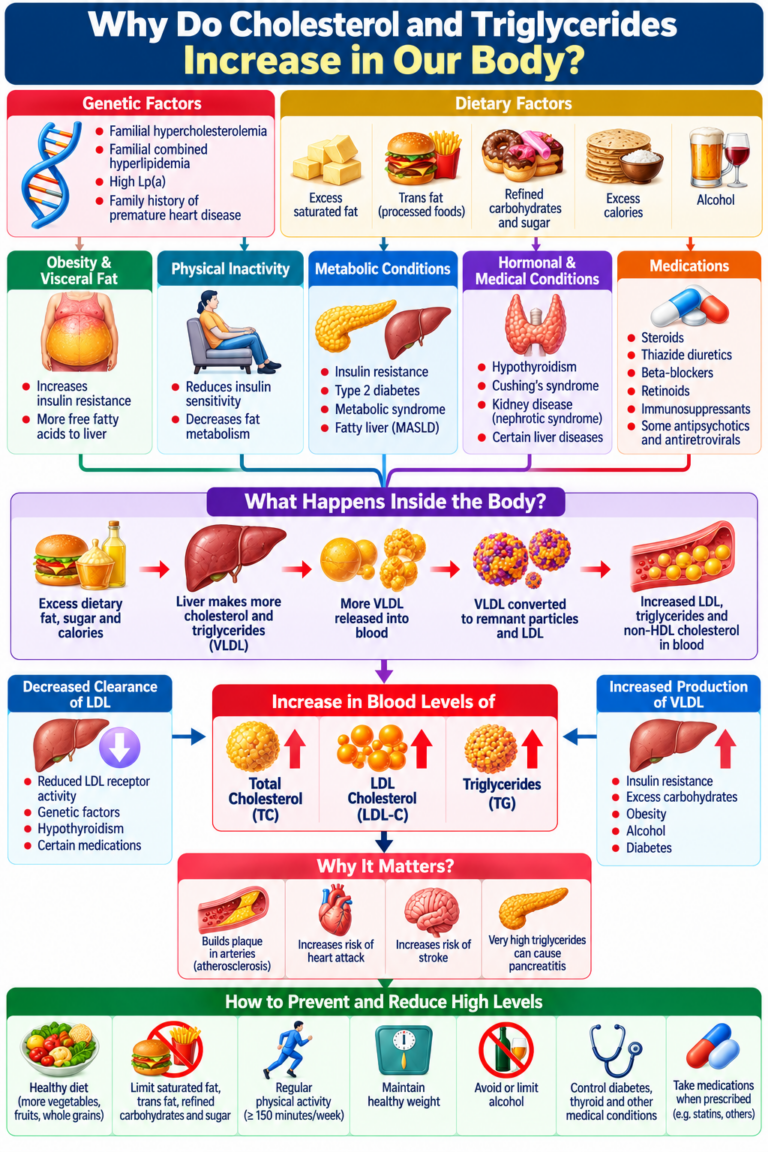
Dyslipidemia may result from a combination of genetic, dietary, metabolic and lifestyle factors.
Common causes include:
- Excess saturated fat intake
- Excess refined carbohydrates
- Obesity
- Insulin resistance
- Diabetes
- Physical inactivity
- Smoking
- Excess alcohol intake
- Hypothyroidism
- Kidney disease
- Liver/metabolic disorders
- Certain medications
- Genetic lipid disorders
Some patients have significant dyslipidemia despite a healthy lifestyle because of genetic factors.
Familial Hypercholesterolemia
Familial hypercholesterolemia (FH) is an inherited disorder in which LDL cholesterol remains abnormally high.
FH should be considered when there is:
- Markedly elevated LDL-C
- Premature coronary artery disease
- Strong family history of premature cardiovascular disease
- Multiple relatives with high cholesterol
Recognizing FH is important because earlier treatment can reduce lifetime exposure to high LDL-C.
When FH is suspected, family screening may also be appropriate.
Lipid Profile and Fatty Liver
Lipid abnormalities frequently coexist with metabolic dysfunction-associated steatotic liver disease (MASLD).
A typical metabolic pattern may include:
- Elevated triglycerides
- Low HDL-C
- Increased ApoB/non-HDL-C
- Variable LDL-C
However, fatty liver itself does not mean that a person necessarily has high cholesterol.
The lipid profile should therefore be interpreted separately while considering the patient’s overall metabolic health.
Does Fasting Matter for a Lipid Profile?
A lipid profile can often be performed without fasting.
The American Heart Association notes that lipid testing may be fasting or non-fasting depending on the clinical situation.
However, fasting testing may be preferred in certain circumstances, particularly when:
- Triglycerides are markedly elevated
- A previous non-fasting result was abnormal
- There is suspected metabolic or genetic dyslipidemia
- A clinician specifically wants a fasting measurement
The decision should be based on the clinical context rather than assuming that every lipid test requires fasting.
How Should a Lipid Profile Be Interpreted?
A useful clinical approach is:
Step 1 — Look at LDL-C
Ask:
Is LDL elevated, and what is the patient’s cardiovascular risk?
Step 2 — Look at triglycerides
Ask:
Are triglycerides normal, borderline, high or very high?
Step 3 — Look at HDL-C
Consider HDL as part of the overall risk profile rather than as an isolated treatment target.
Step 4 — Calculate non-HDL-C
Non-HDL-C = TC − HDL-C
Step 5 — Consider ApoB and Lp(a)
These may provide additional information when cardiovascular risk is uncertain or when there is suspected lipid discordance or inherited risk.
Step 6 — Assess the patient, not just the numbers
Consider:
- Age
- Blood pressure
- Diabetes
- Smoking
- Kidney function
- Family history
- Previous cardiovascular disease
- Body composition/metabolic health
- Lp(a)
- ApoB
- Other risk-enhancing factors
What Can Be Done to Improve a Lipid Profile?
Lifestyle remains a foundation of dyslipidemia management.
1. Improve dietary quality
Emphasize:
- Vegetables
- Fruits
- Whole grains
- Pulses and legumes
- Nuts and seeds in appropriate portions
- Fish where culturally and individually appropriate
- Healthy unsaturated fats
Limit excessive:
- Saturated fats
- Trans fats
- Highly processed foods
- Refined carbohydrates
- Sugary beverages
- Excess alcohol
2. Maintain regular physical activity
Regular physical activity supports cardiovascular health, metabolic health and triglyceride control.
The appropriate activity program depends on age, health status and physical capacity.
3. Manage body weight appropriately
For people with excess adiposity, clinically appropriate weight reduction can improve:
- Triglycerides
- Insulin resistance
- Metabolic health
- Overall cardiovascular risk
4. Control blood pressure and blood glucose
Cardiovascular risk is determined by multiple interacting factors.
Therefore, treating cholesterol while ignoring:
- Hypertension
- Diabetes
- Smoking
- Physical inactivity
does not provide complete cardiovascular risk reduction.
When Are Medicines Needed?
Not everyone with an abnormal lipid profile needs medication immediately.
Medication decisions depend on:
- LDL-C level
- Triglyceride level
- Existing ASCVD
- Diabetes
- Age
- Blood pressure
- Kidney disease
- Family history
- Lp(a)
- ApoB
- Overall estimated cardiovascular risk
- Possible familial hypercholesterolemia
Statins remain a foundation of lipid-lowering therapy when medication is indicated. The 2026 ACC/AHA guideline also describes non-statin options such as ezetimibe, bempedoic acid and PCSK9-directed therapies for selected patients whose LDL-C remains above the desired level despite appropriate initial therapy.
Medication should therefore be selected according to the patient’s risk category rather than based solely on one abnormal number.
Common Mistakes When Reading a Lipid Profile
Mistake 1: Looking only at total cholesterol
Total cholesterol does not tell the entire story.
Mistake 2: Assuming high HDL cancels high LDL
It does not.
Mistake 3: Treating triglycerides in isolation
The cause of elevated triglycerides should be investigated.
Mistake 4: Ignoring family history
Inherited lipid disorders can cause significant cardiovascular risk even in otherwise healthy individuals.
Mistake 5: Never checking Lp(a)
The 2026 ACC/AHA guideline recommends measuring Lp(a) at least once in adulthood.
Mistake 6: Assuming medication is unnecessary because there are no symptoms
Dyslipidemia is usually asymptomatic. Atherosclerosis can develop silently over many years.
Frequently Asked Questions
Does high cholesterol cause symptoms?
Usually, no. Most people with high cholesterol have no symptoms. A lipid profile is therefore important because it can identify risk before cardiovascular disease becomes clinically apparent.
Is total cholesterol more important than LDL?
No. LDL-C and overall atherogenic particle burden are generally more important for cardiovascular risk assessment than total cholesterol alone.
Is HDL always protective?
Higher HDL is generally associated with lower cardiovascular risk, but simply increasing HDL does not necessarily eliminate cardiovascular risk. LDL and other atherogenic particles remain important.
Can a person with normal LDL still have cardiovascular risk?
Yes. Elevated Lp(a), ApoB, diabetes, hypertension, smoking, kidney disease and other risk factors can increase risk even when LDL-C appears acceptable.
Should everyone have an Lp(a) test?
The 2026 ACC/AHA guideline recommends measuring Lp(a) at least once in adulthood because it can identify genetically determined cardiovascular risk.
Is a fasting lipid profile always necessary?
No. Many lipid profiles can be performed without fasting. Fasting may be particularly useful in selected patients, especially when triglycerides are substantially elevated or when a clinician specifically requires a fasting measurement.
The Bottom Line
A lipid profile is much more than a total cholesterol test.
The most clinically useful approach is to understand:
Total cholesterol → LDL-C → HDL-C → triglycerides → non-HDL-C → ApoB/Lp(a) when appropriate → overall cardiovascular risk.
The goal is not simply to make one laboratory number “normal.” The goal is to reduce long-term exposure to atherogenic lipoproteins and lower the individual’s risk of heart attack, stroke and other atherosclerotic cardiovascular disease.
Modern guidelines increasingly emphasize earlier identification, individualized risk assessment and appropriate LDL-C lowering, rather than relying on total cholesterol alone.
A simple clinical message to remember:
Don’t treat the lipid report alone. Treat the patient’s cardiovascular risk.