
You wake up in the morning, make a cup of tea, take your blood pressure tablet, and sit down with your BP machine. The monitor shows 158/96 mmHg.
You become worried. Is your medicine not working? Is something wrong with your heart?
You wait a few minutes, check again, and get 143/88. Later, after breakfast and a short walk, the reading is different again.
Which number should you trust?
This situation is familiar to many people who monitor their blood pressure at home. The important thing to understand is that blood pressure changes naturally throughout the day, and the way you measure it can affect the result.
A reading taken immediately after walking, drinking tea, climbing stairs or arguing with someone may not reflect your resting blood pressure. An incorrectly sized cuff or an unsupported arm can also distort the measurement.
The good news is that a few simple changes can make home blood pressure monitoring more useful.
Why home blood pressure monitoring matters
High blood pressure, also called hypertension, is often called a silent condition because many people feel perfectly well even when their blood pressure is elevated.
According to the World Health Organization’s 2025 hypertension fact sheet, an estimated 1.4 billion adults aged 30–79 worldwide had hypertension in 2024. Approximately 44% were unaware of their condition, and only around 23% had their blood pressure under control.
These are global figures, not India-specific estimates. Nevertheless, they highlight why regular, reliable measurement matters.
High blood pressure that remains uncontrolled can increase the risk of stroke, heart disease and kidney disease.
Home monitoring helps you and your doctor understand what happens outside the clinic. It can help assess whether treatment is working and identify differences between clinic and home readings.
However, a home monitor does not diagnose every case on its own, and a normal reading does not mean that prescribed treatment is no longer needed.
1. Measuring BP immediately after waking up
Many people check their blood pressure as soon as they get out of bed.
Others measure it immediately after using the bathroom, preparing tea, getting dressed or hurrying around the house.
Blood pressure changes naturally during the day, and physical activity can temporarily affect the reading.
What should you do instead?
Choose a consistent time. For a morning measurement, empty your bladder, sit quietly for at least five minutes, and measure before breakfast and, when this fits your prescribed schedule, before taking your morning BP medicine.
Do not delay or change the timing of your prescribed medication merely to obtain a particular reading. Follow the measurement and medication schedule agreed with your clinician.
2. Drinking tea or coffee just before checking BP
For many Indian households, the morning routine begins with chai.
Caffeine can temporarily increase blood pressure in some people. Smoking and exercise can also affect the reading.
If you check your BP immediately after tea or coffee, the result may not represent your usual resting level.
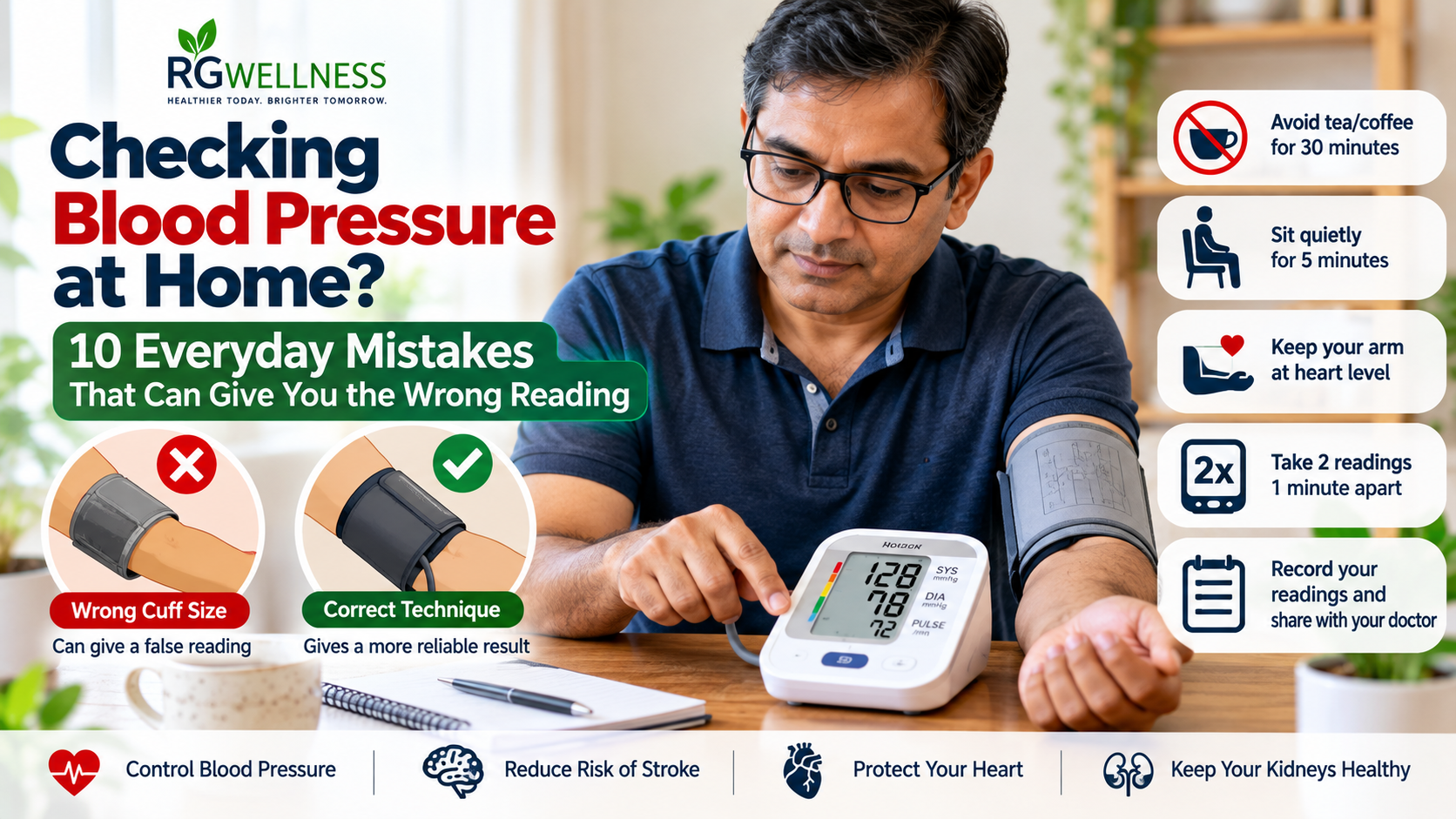
A simple rule: Avoid caffeine, smoking and exercise for at least 30 minutes before measuring. Sit quietly for five minutes immediately before taking the reading.
You do not necessarily need to stop drinking tea altogether. The purpose is to measure consistently under comparable conditions.
3. Checking BP immediately after climbing stairs
Imagine climbing two flights of stairs, carrying groceries or walking quickly to catch a bus. You then sit down and immediately put on the BP cuff.
The reading may be higher because your body has just been physically active.
This does not automatically mean your hypertension has worsened.
What to do: Wait until you have avoided exercise for at least 30 minutes, then sit quietly for at least five minutes before measuring.
If you feel unwell after activity, do not rely on a home BP reading alone to decide whether you need medical care.
4. Sitting on the bed or sofa with poor posture
You may check your BP while sitting cross-legged on the bed, leaning back on a soft sofa or keeping your legs folded beneath you.
This is comfortable, but it is not the ideal measurement position.
For a more reliable reading:
- Sit in a chair with your back supported.
- Keep both feet flat on the floor.
- Do not cross your legs.
- Rest your arm on a table or another firm surface.
- Keep the middle of the cuff approximately at heart level.
- Place the cuff directly on bare skin.
Do not talk, text or scroll through your phone during the measurement.
The American Heart Association recommends these steps because posture and positioning can influence the result.
5. Using the wrong cuff size
A BP monitor may be expensive and well known, but the wrong cuff size can still produce an inaccurate result.
A cuff that is too small may give an artificially high reading. A cuff that is too large may give an artificially low reading.
Check your upper-arm circumference and the manufacturer’s recommended cuff range before buying a monitor.
An automatic upper-arm monitor that has been independently validated is generally preferred for routine home monitoring. Wrist devices may be appropriate in selected circumstances when advised by a healthcare professional, but they require particularly careful positioning.
Take your monitor to your next appointment so your healthcare professional can check your technique and compare its readings with clinic equipment.
6. Taking only one reading and believing it completely
Suppose your first reading is 151/92 mmHg. You become anxious and immediately measure again, then again, hoping to see a lower number.
Repeated checking can increase worry and produce an unstructured collection of results that is difficult to interpret.
Instead, follow a planned schedule.
The recommended approach:
- Sit quietly for five minutes.
- Take the first reading.
- Wait approximately one minute.
- Take the second reading.
- Record both results.
Do not select only the lowest number. Your clinician needs an honest record of the measurements.
A single high reading is not always an emergency, but repeated high readings deserve attention.
7. Panicking when the BP number is high
A reading of 160/95 may frighten someone who has never seen that number before.
The person may begin worrying about a heart attack, check the monitor repeatedly and become increasingly anxious.
Anxiety can influence blood pressure, making the situation more difficult to interpret.
The sensible approach is to sit quietly, repeat the measurement using the correct technique and record the results.
If readings remain above your usual range, contact your healthcare professional for advice rather than repeatedly checking every few minutes.
Do not ignore persistent elevation, but do not assume that every isolated high reading means an emergency.
8. Stopping medicine because the reading becomes normal
This is one of the most important mistakes to avoid.
Someone takes prescribed medication regularly and starts recording readings around 124/78 mmHg. They conclude that the hypertension has disappeared and decide to stop the tablets.
A few days later, the blood pressure may rise again.
Normal readings may mean that your treatment is working.
Hypertension often requires long-term monitoring and treatment. Whether medication can be reduced depends on the person’s health, repeated readings and clinical assessment.
Never stop, reduce or change prescribed BP medication solely because of a normal home reading. Discuss any treatment change with the prescribing clinician.
9. Ignoring everyday factors that affect blood pressure
Blood pressure is influenced by more than medication alone.
Everyday factors may include:
- High salt intake, including frequent salty snacks, pickles, papad and packaged foods.
- Poor sleep or possible sleep apnoea.
- Stress, pain or acute illness.
- Physical inactivity.
- Certain medicines, including some anti-inflammatory painkillers and decongestants.
- Alcohol and tobacco exposure.
- Missing prescribed medication.
Do not stop a medicine on your own if you suspect it is affecting your BP. Share your medication and supplement list with your clinician.
Small, sustainable changes to diet, physical activity, sleep and medication adherence can support better blood pressure control.
10. Measuring at different times every day
One day you check BP at 6:30 am before tea. The next day you measure it at 10 am after breakfast. On another day, you check it immediately after returning from work.
These measurements may all be useful in context, but comparing them without considering the circumstances can be misleading.
Try to measure at consistent times, following your clinician’s advice.
For many adults, a clinician may recommend morning and evening measurements over several days when evaluating blood pressure or reviewing treatment. A common protocol uses two readings one minute apart at each session.
The American Heart Association’s scientific statement on blood pressure measurement describes a preferred monitoring period of at least seven days, with a minimum of three days potentially sufficient in some circumstances. Your clinician may use a different schedule depending on the purpose of monitoring.
Do not continue intensive daily monitoring indefinitely unless it has been recommended. Once your BP is stable, ask how frequently you should check it.
A simple seven-day home BP diary
Use this example to organise your readings. The values below are illustrative, not actual patient results.
| Day | Morning reading 1 | Morning reading 2 | Evening reading 1 | Evening reading 2 |
|---|---|---|---|---|
| Monday | 142/88 | 138/86 | 136/84 | 134/82 |
| Tuesday | 139/86 | 136/84 | 133/82 | 132/80 |
| Wednesday | 137/85 | 135/83 | 134/81 | 131/80 |
| Thursday | 136/84 | 134/82 | 132/80 | 130/79 |
| Friday | 135/83 | 133/82 | 131/80 | 130/78 |
| Saturday | 134/82 | 132/80 | 131/79 | 129/78 |
| Sunday | 133/81 | 131/80 | 130/78 | 128/78 |
These example values illustrate how to record readings; they do not demonstrate a treatment response or establish an individual target.
Record your actual results, including unusually high or low readings. If you experience symptoms, note them too.
Bring the diary and your monitor to your appointment. Your doctor can review the average, check whether the device is accurate and decide whether your treatment needs adjustment.
What do the two BP numbers mean?
Blood pressure is written as systolic pressure over diastolic pressure.
For example, in a reading of 120/80 mmHg:
- 120 is the systolic pressure: the pressure in your arteries when your heart contracts.
- 80 is the diastolic pressure: the pressure when your heart relaxes between beats.
Both numbers matter.
The American Heart Association classifies adult readings of less than 120 systolic and less than 80 diastolic as normal. Its categories for elevated BP and hypertension differ from the diagnostic framework used by some other health systems.
In India, the WHO uses 140/90 mmHg or higher as a general threshold for hypertension in clinical measurement, confirmed on separate days. Individual treatment targets may be lower, depending on diabetes, kidney disease, cardiovascular disease, age and other clinical circumstances.
Your personal target should be agreed with your clinician. Do not diagnose yourself using a single reading or an online chart.
When is a high BP reading an emergency?
A reading above 180 mmHg systolic and/or 120 mmHg diastolic is in the severe range.
If you obtain a reading in this range, pause briefly and repeat it using correct technique.
- If it remains very high without symptoms, contact a healthcare professional immediately for guidance.
- If it occurs with chest pain, shortness of breath, new weakness or numbness, difficulty speaking, confusion or changes in vision, seek emergency medical care immediately.
Do not wait for repeated measurements or assume that you are safe because a subsequent reading falls.
Symptoms and the person’s overall condition matter as much as the number.
Five everyday habits that support better BP control
Correct measurement tells you what is happening. Healthy habits and appropriate treatment help you manage the underlying risk.
1. Reduce excess salt. Limit frequent high-salt foods and check labels on packaged products. WHO recommends less than 2,000 mg of sodium daily for most adults, equivalent to less than 5 g of salt from all sources. People with specific medical conditions may need individual advice.
2. Walk regularly. Build regular physical activity into your routine, such as walking, according to your ability and medical advice.
3. Eat balanced meals. Include vegetables, fruit, pulses and suitable whole grains. Limit frequent highly processed foods and excess added sugar.
4. Protect your sleep. Keep a regular sleep schedule and discuss loud snoring or persistent daytime sleepiness with your clinician.
5. Take medication consistently. Use reminders or a pill organiser if needed. Ask your clinician or pharmacist what to do if you miss a dose rather than doubling the next dose without advice.
These habits support cardiovascular health but do not replace prescribed treatment when medication is needed.
Frequently asked questions
Should I check my BP before or after taking medicine?
For monitoring treatment, morning readings are often taken before the morning dose, if this fits the schedule agreed with your clinician. Do not delay, skip or change your medication to obtain a particular reading.
Is 140/90 always dangerous?
Not every reading of 140/90 represents an emergency. However, repeated readings around or above this level warrant clinical assessment. Your personal target may be different depending on your medical history.
Why is my BP higher in the clinic than at home?
Some people have a white-coat effect, in which clinic readings are higher than their usual readings outside the clinic. Others have masked hypertension, with normal clinic readings but elevated readings elsewhere. Home monitoring or ambulatory monitoring can help clarify the difference.
Can I check BP after eating?
For a standard resting measurement, follow a consistent schedule and avoid measuring immediately after physical activity or caffeine. If your clinician has given you a specific protocol, follow it.
Should I measure BP every hour?
Usually not. Frequent unscheduled measurements can create unnecessary anxiety. Follow a planned schedule recommended by your clinician, with additional assessment if symptoms or very high readings occur.
Which arm should I use?
Ask your healthcare professional to check both arms initially. If there is a consistent difference, they may recommend using the arm with the higher readings for future monitoring.
Final message: Do not let one number control your day
Your blood pressure monitor is a tool, not a verdict.
A single reading cannot tell the whole story. The time you measure, your posture, the cuff size, recent activity and your treatment all matter.
Sit quietly. Use the correct cuff. Take two readings. Record the results. Review the pattern with your doctor.
And remember: never stop your prescribed BP medicine just because today’s reading looks normal.
At RGWELLNESS, our goal is to help you understand your numbers, make informed decisions and build habits that support long-term health.
Medical disclaimer
This article is for educational purposes and does not replace individual medical advice. Blood pressure targets and treatment decisions should be personalised by a qualified healthcare professional.
References
- World Health Organization. Hypertension fact sheet. Published 25 September 2025.
- American Heart Association. Home Blood Pressure Monitoring.
- Muntner P, et al. Measurement of Blood Pressure in Humans: A Scientific Statement From the American Heart Association.
- World Health Organization. Guideline for the pharmacological treatment of hypertension in adults.